


The two words are used interchangeably now, which is exactly the problem.
Famous means legible to a large audience. Influential means capable of changing what that audience thinks, buys, cites, questions, or does next. The overlap is real there are people who are both, genuinely, and whose visibility and effect on their field are proportional to each other. But the overlap is smaller than the culture suggests. And the gap between them the gap where someone has a very large audience that does not particularly act, or a very small audience that acts on everything is where some of the most interesting careers and media platforms of the last decade are being built.
This essay is about the gap.
The gap matters because it is where bad media buying happens, where creators misunderstand their own power, and where institutions continue mistaking visibility for authority. A person can be everywhere and move very little. Another can appear rarely and change the decisions of the people who matter.
It is also about why the conflation of the two categories is not an innocent linguistic error. It is a structurally useful confusion for everyone who profits from the attention economy’s primary metric: reach. Reach is measurable, sellable, and legible across every media buying conversation in the world. Influence is messier, harder to attribute, and much harder to scale without eroding itself.
Which is why the honest conversation about them is almost never had.
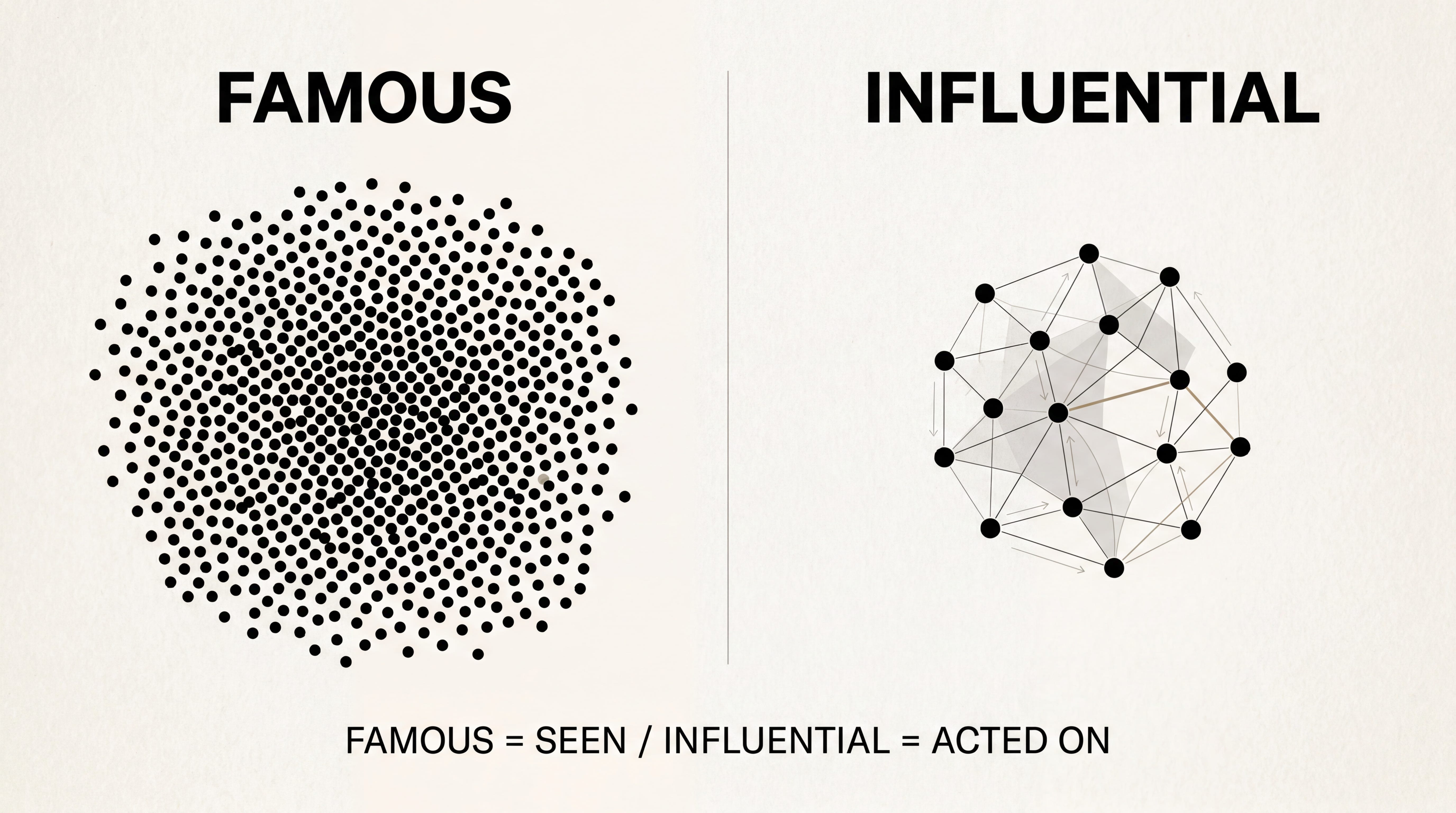
The Definition Problem
The conflation of fame and influence did not begin with social media, but social media completed it.
Before the platform era, the distinction was clearer. A politician could be famous but have no actual influence over policy, if their power was ceremonial or their party had no majority. A scientist could have enormous influence over a field redefining the research questions everyone else was working on while being completely unknown to a general audience. A fashion editor could move a trend by making a single styling decision on a single shoot, and the number of people who knew their name was immaterial to the force of that decision.
Platform metrics collapsed this distinction. Follower count became the universal proxy for significance. If the number is large, the account is important. The reasoning is not malicious it is just that reach is the one thing the platforms can measure and report with precision. Effect is harder to track, slower to emerge, and contextually dependent in ways that do not fit neatly into a dashboard.
So we optimised for the measurable thing and called it the important thing. And the measurable thing, it turns out, is not always the important thing.
The metrics are not lying. They are measuring the wrong thing.
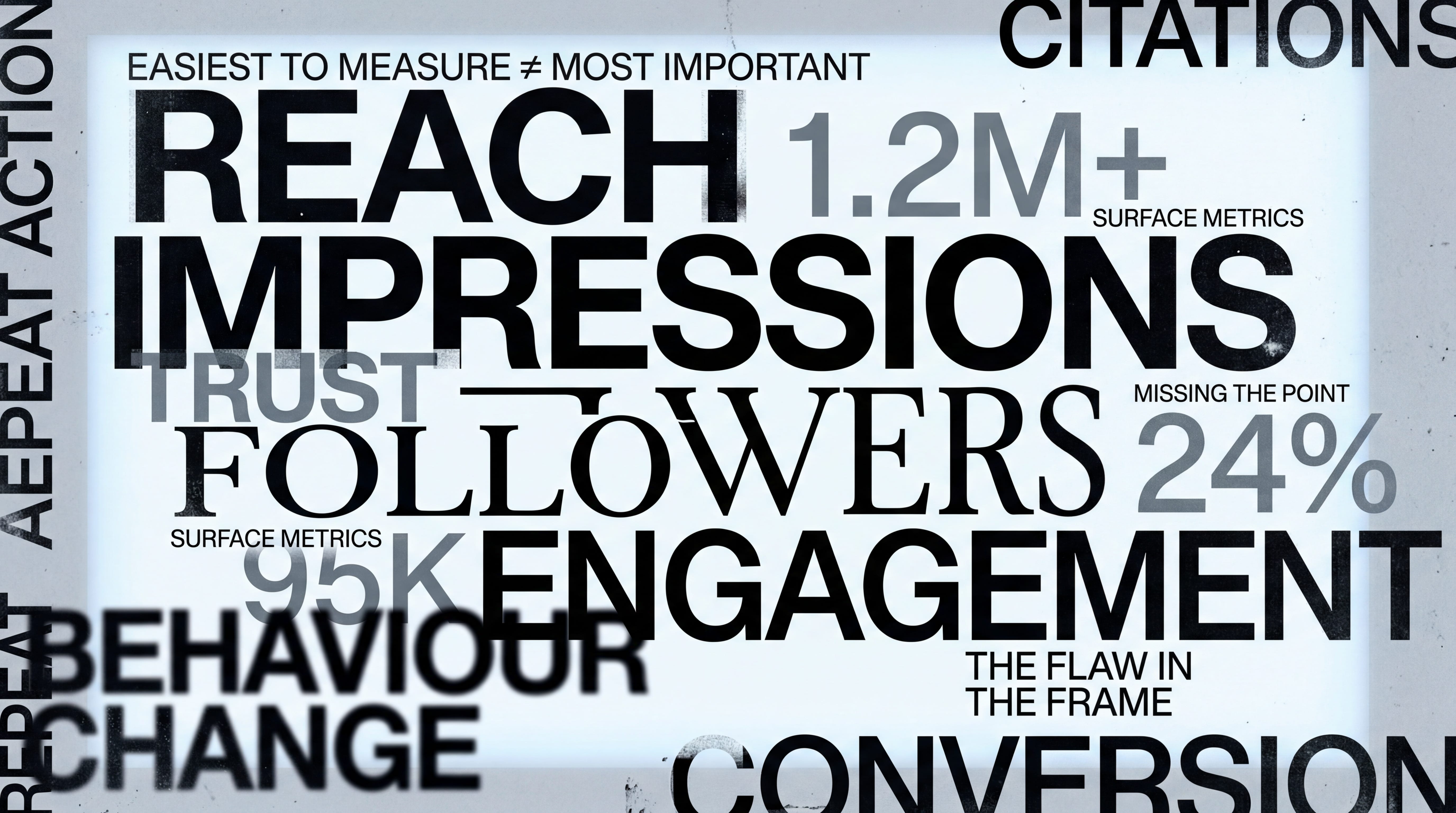
Reach Is Not Trust
The reason reach so often fails to become influence is simple: attention is not the same as trust.
A large, broadly acquired audience is composed of people with different and sometimes contradictory reasons for following the account. Some came for one type of content, some came for another. Some came because the algorithm placed the account in front of them at a moment when it solved a passing curiosity. Some came because someone they trust recommended it.
This heterogeneous audience is real those are real people, and their follows are real follows. But it is not a community of trust. It is an accumulation of attention. And accumulations of attention behave differently from communities of trust in one critical way: they are extremely difficult to move.
Moving an audience changing their behaviour, shifting their purchasing decisions, altering their intellectual framework for a subject requires trust. Trust is built slowly, through consistency, specificity, and demonstrated competence over time. It cannot be manufactured through a viral moment, however large. The viral moment brings reach. The subsequent months and years of consistent, specific, useful work build trust.
The relationship between reach and trust is not inverse having more reach does not necessarily mean having less trust. But the correlation between them is weaker than most platform-era thinking assumes. Some of the highest-trust audiences in any field are very small. Some of the largest audiences are built on entertainment value rather than intellectual authority, and entertainment is not the same engine of change as trust.

Three Patterns Worth Understanding
The first pattern: the media figure with a modest following and an outsized industry effect.
Across fashion, finance, food and culture, there are writers and editors whose readership numbers in the low tens of thousands sometimes lower whose opinions materially affect what the people they reach decide to cover, commission, buy, stock, and make. Their influence is disproportionate to their reach because their audience is composed almost entirely of people with structural power in the relevant industry.
The leverage here is not numerical. It is positional.
One recommendation from the right editor can move a buyer. One sentence from the right analyst can reframe a boardroom. One private newsletter read by the right five thousand people can matter more than a viral post consumed by five million people who never act.
The right ten thousand readers are a different instrument from a random ten million.
The second pattern: the large-reach account with very low commercial conversion.
An account with millions of followers that consistently underperforms in brand partnerships, merchandise, or any other commercial mechanism that requires the audience to take an action. The followers are real. The engagement is real. But the engagement is aesthetic or emotional rather than decisional. The audience is watching, appreciating, even loving the content. They are not being moved to do things differently.
This is not a failure of the creator. It is a description of what the account built. Some content is built to entertain, and it entertains at scale. Entertaining at scale and influencing at scale are different projects.
The third pattern: the slow builder.
The person who has been consistent in a specific domain for five or more years, whose audience has grown slowly but whose trust is exceptionally high, whose recommendations consistently produce action. These accounts are frequently undervalued by brand partnerships because their reach number looks modest. They are, in practice, the most reliable commercial partners for the right product and the most significant intellectual forces in their field.
The brands that have worked out how to identify and work with this third category are significantly ahead of the industry on media buying strategy.
Which One To Build
This is the question everyone is circling without quite asking it directly.
The honest answer is that the choice is not entirely yours. You can build toward influence through specificity, depth, consistency, demonstrated expertise, and genuine usefulness to the people you are trying to reach and still acquire reach, if what you are producing connects broadly enough. You can build toward reach through entertainment, trend responsiveness, platform optimisation and still acquire trust, if the underlying quality is there.
What you cannot do, or cannot do for long, is build the appearance of influence on the infrastructure of reach. The audience built through entertainment does not behave like the audience built through trust, regardless of what the number looks like.
OFFF DUTY has made a specific choice in this: depth before reach. Not because reach is unimportant, but because the kind of reach that is useful to this publication the kind that compounds over time rather than spikes and dissipates is built on the back of a reading community that trusts the editorial judgment, not an audience that happened to see a particularly well-optimised post.
The archive is being built to hold. Each essay is an argument, not a stimulus. The goal is a reader who comes back because the thinking is useful, not one who returns because the algorithm served the content again.
That is a different project from maximising the follower count.
It is also a considerably more interesting one.

Forward this to someone building an audience who is spending more time on the number than on the effect.
The paid essay published yesterday — What Fame Actually Costs — is the longer version of the argument this one begins. The archive is open.