


Some brands arrive in Milan trying to prove they belong. Absent Findings arrived with a question.
The question is the title of the collection — What’s the Color of My Voice? and it is worth pausing on before we go any further, because it tells you everything about why this matters and why it sits, a little unexpectedly, inside an issue devoted to Italy.
For its SS27 presentation, the Dubai-based brand returned to the Milano Fashion Week Men’s Calendar for the second time in six months. Most brands that earn a place on that calendar arrive trying to announce themselves: loud enough, fast enough, certain enough to be remembered.
Absent Findings did the opposite.
It arrived to ask.
And in a week built on volume, a question whispered turns out to carry further than a statement shouted.
We are not, for once, looking at an Italian house this week.
We are looking at something more interesting for The Italy Issue: at what Milan the great validating system of global menswear chooses to let into the conversation.
Because the Milan calendar is not only where Italian fashion performs its mastery. It is where new design languages are tested, absorbed, and either dismissed or invited to stay.
And what the city invited this season was a brand whose entire premise runs against the grain of spectacle: a refusal of pomp, a belief in the intimacy of making, and a question instead of an answer.
That Milan made room for it tells you something is shifting in what the system values.
To understand the collection you have to understand where it was made, because the location is the thesis.
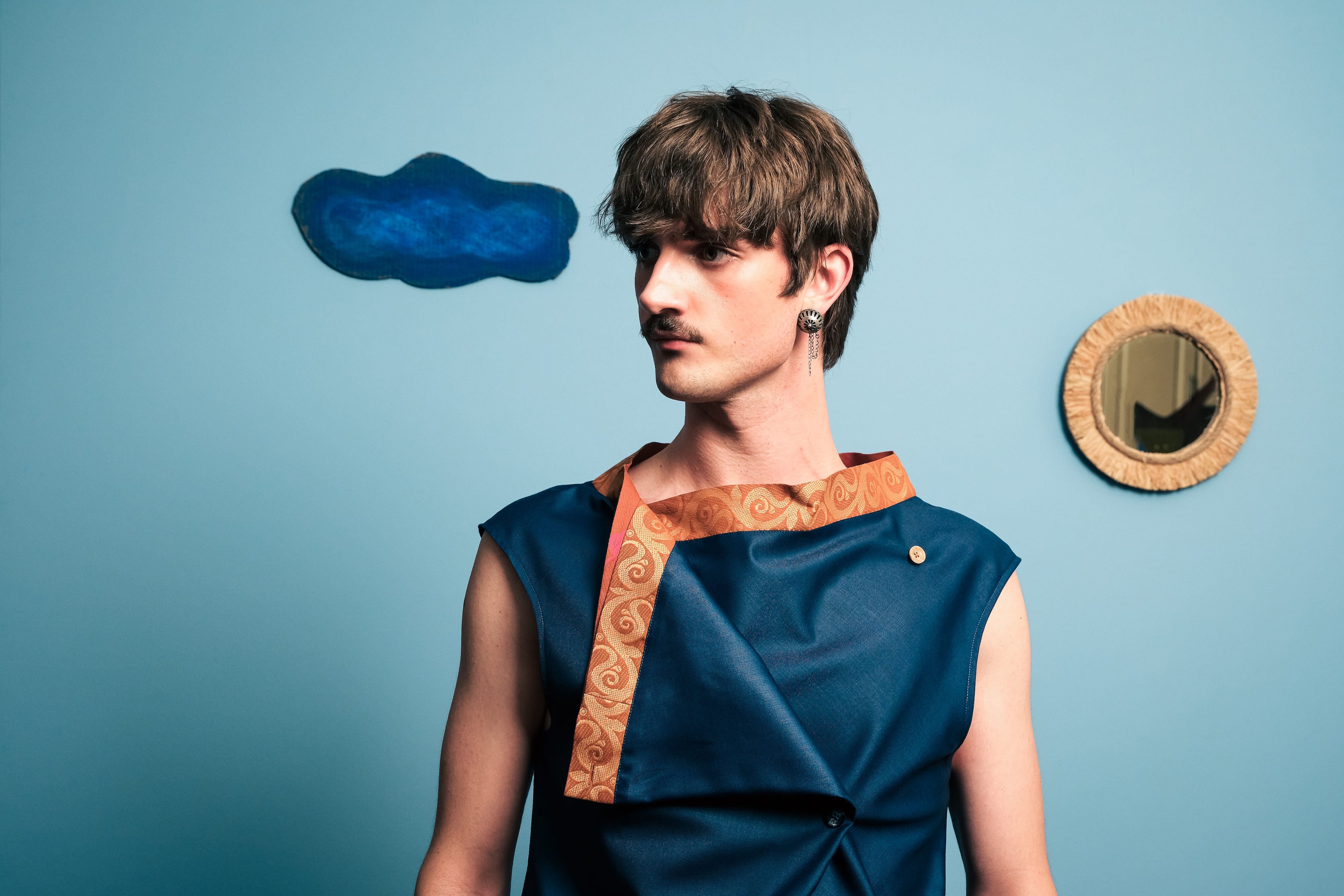
What’s the Color of My Voice? was conceived and filmed inside the four walls of the studio and, more tenderly, inside founder Shivin Singh’s childhood apartment.
This is not a logistical footnote. It is the whole argument.
In a moment when the world can feel heavy-handed, when logic feels suspended and a quiet helplessness sits in the background of everything, Absent Findings turned inward not to escape, but to make.
The studio becomes a refuge, and making becomes a quiet act of rebellion: the belief that to stay with the work, to cover the walls with references and drawings and textures and mistakes and small moments of beauty, is meaningful in itself.
No spectacle. No hollow grand statement.
Just the intimacy of making and the discipline of showing up.
There is a phrase the OFFF DUTY reader will recognise from everything we have published this month, and it applies here with unusual force: authorship is the new luxury. Not polish — authorship.
A world built so specifically, so personally, so saturated with one maker’s actual references and inheritances that it cannot be copied quickly, because there is no shortcut to a childhood, no fast route to a memory.
The collection draws on the surrealist worlds of Leonora Carrington, the costume geometry of Oskar Schlemmer, Victorian frills, the grammar of prep uniforms and metabolises all of it into something that could only have come from this person, in this room.
That specificity is the moat. You cannot reverse-engineer a voice. And the clothes themselves enact the question they are named for.
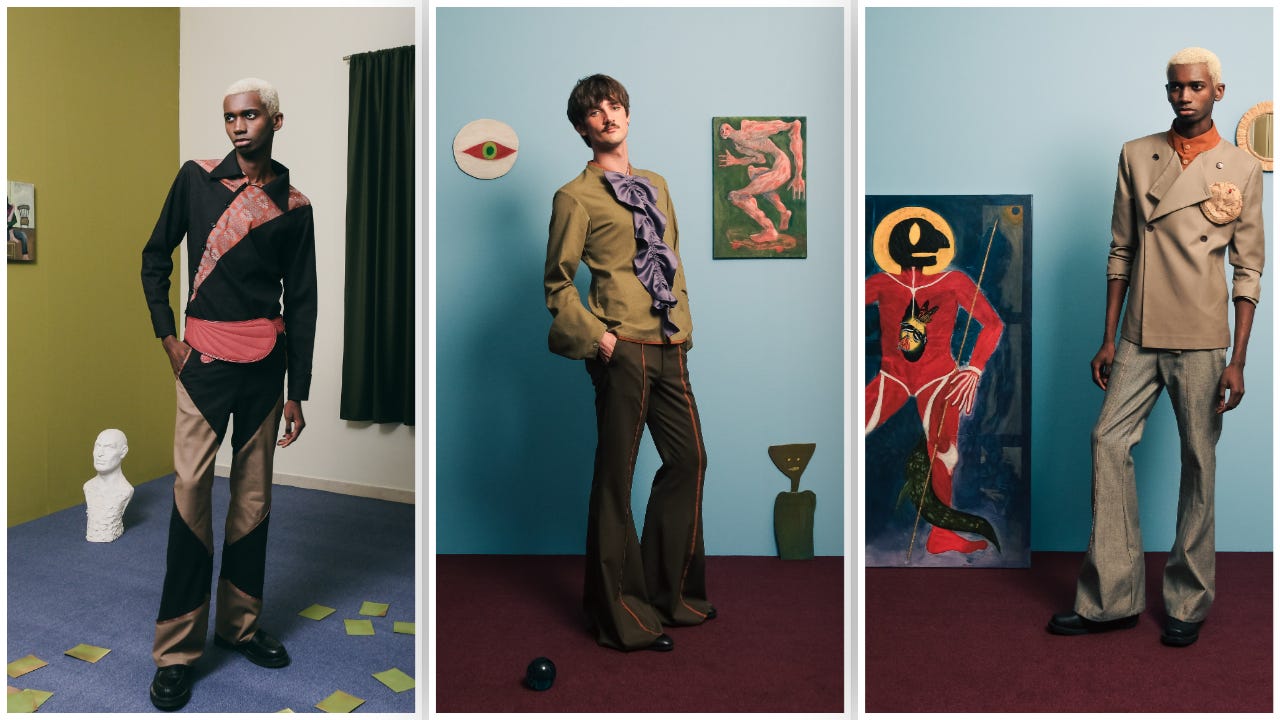
Controlled silhouettes tailored jackets, vests, shirts, trousers, the disciplined vocabulary of the uniform are interrupted, again and again, by gestures of ornament.
Ruffles.
Gathered panels.
Decorative trims.
Unexpected flashes of colour that feel almost emotional in their placement, as if something romantic, theatrical, instinctive were pushing its way up through the discipline of the garment.
The uniform here is not about conformity.
It becomes about intention about the desire to present oneself with care, to show up in one’s best image, to add honest and beautiful meaning to the world rather than merely survive within it.
Each piece sits exactly on the line between restraint and expression, between the uniform and the voice inside it.
That is the collection’s entire emotional architecture, worn on the body.
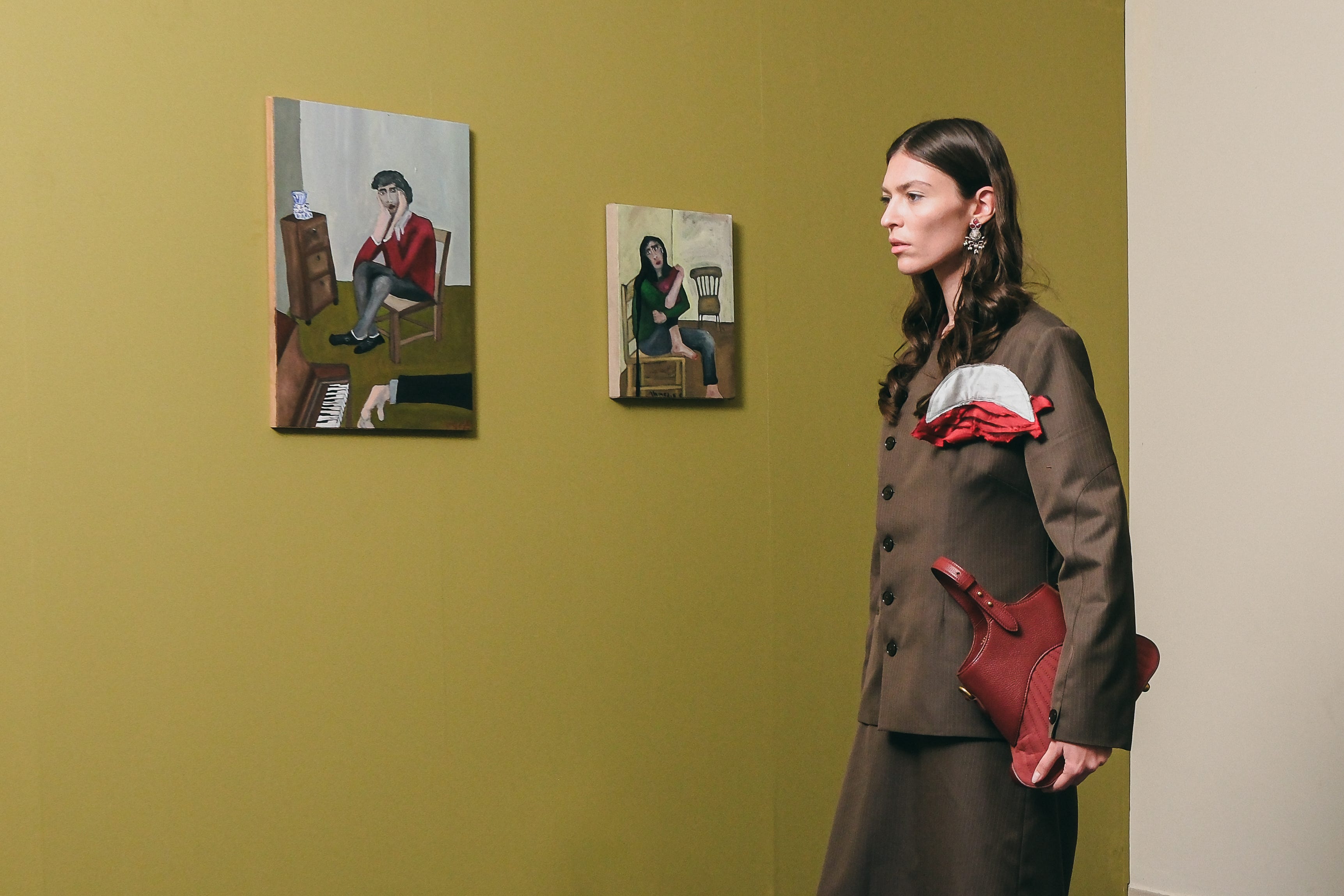
The most moving element, and the most personal, is the use of heirloom saris woven through the collection as trims, accents, frills, piping, and delicate interventions.
They are not treated as nostalgic artefacts behind glass.
They are alive.
Against the structure of tailoring and uniform codes, these inherited fabrics soften everything, carrying traces of family, identity, and the quiet weight of things passed down.
This is inheritance made literal the maker’s own lineage, cut and stitched directly into the garment and it is the most powerful answer the collection gives to its own question.
What’s the colour of my voice?
It is, in part, the colour of what your family handed you, sewn where the eye least expects to find it.
There is even a shift in the brand’s whole palette that mirrors the emotional opening.
Absent Findings moved away from the desaturated coolness of its earlier work toward colour with a new openness — olive, rust, burgundy, lilac, ochre, muted blue, deep brown — arriving with a quiet but deliberate force.
The argument underneath is generous and, I think, important: beauty does not need to be over-intellectualised to be meaningful.
There is urgency in allowing joy to exist, in admitting that colour can simply make us feel more alive.
Darkness and brightness can sit together.
One can love Joy Division and still be moved by the aesthetic world of Pink Flamingos.
That refusal to choose between depth and delight is, quietly, a radical position in fashion right now. So here is why this belongs in The Italy Issue, and why we made it free for everyone to read.
For a Dubai-based brand to appear on the Milan calendar twice in six months is not merely a milestone for one label.
It is a signal.
Regional fashion is no longer asking permission to be included; it is arriving with a language of its own and finding that the great Italian system, the one we have spent all month admiring for its mastery of restraint, recognises the same value when it appears in an unexpected accent.
Milan validated a brand whose whole philosophy is restraint, intimacy, inheritance, and the refusal of spectacle which is to say, Milan recognised itself, told in a new voice.
The New Geography of Fashion Authority
This is the part worth paying attention to beyond the collection itself.
Fashion’s geography is changing, but not in the simplistic way people often describe it. It is not that one capital is replacing another, or that the old centres no longer matter.
Milan still matters precisely because it has the power to confer context. The calendar is not only a schedule; it is a filtering system, a way of saying: this language belongs in the conversation.
What is changing is the direction from which that language arrives.
For a long time, regional fashion was expected to perform legibility for the centre. It had to arrive already translated, already explained, already softened into a version of itself that could be understood quickly by buyers, editors, and institutions trained to recognise only certain codes.
The new generation is less interested in that translation. It is not asking to be made acceptable by becoming less specific.
That is why Absent Findings matters here.
The brand does not arrive by erasing its context. It arrives with childhood rooms, inherited saris, surrealist references, prep codes, emotional colour, and the intimacy of a studio wall.
It does not flatten the personal into the universal. It makes the personal so precisely rendered that the universal has to come toward it.
That is a different kind of fashion authority. Not authority borrowed from proximity to Europe. Authority produced through authorship.
The signal is not that a Dubai-based brand appeared in Milan.
The signal is that it appeared without surrendering the strangeness, tenderness, and specificity of its own voice and Milan still made space for it.
That is when inclusion becomes more interesting than access.
Access says: you may enter.
Inclusion says: you may alter the room.
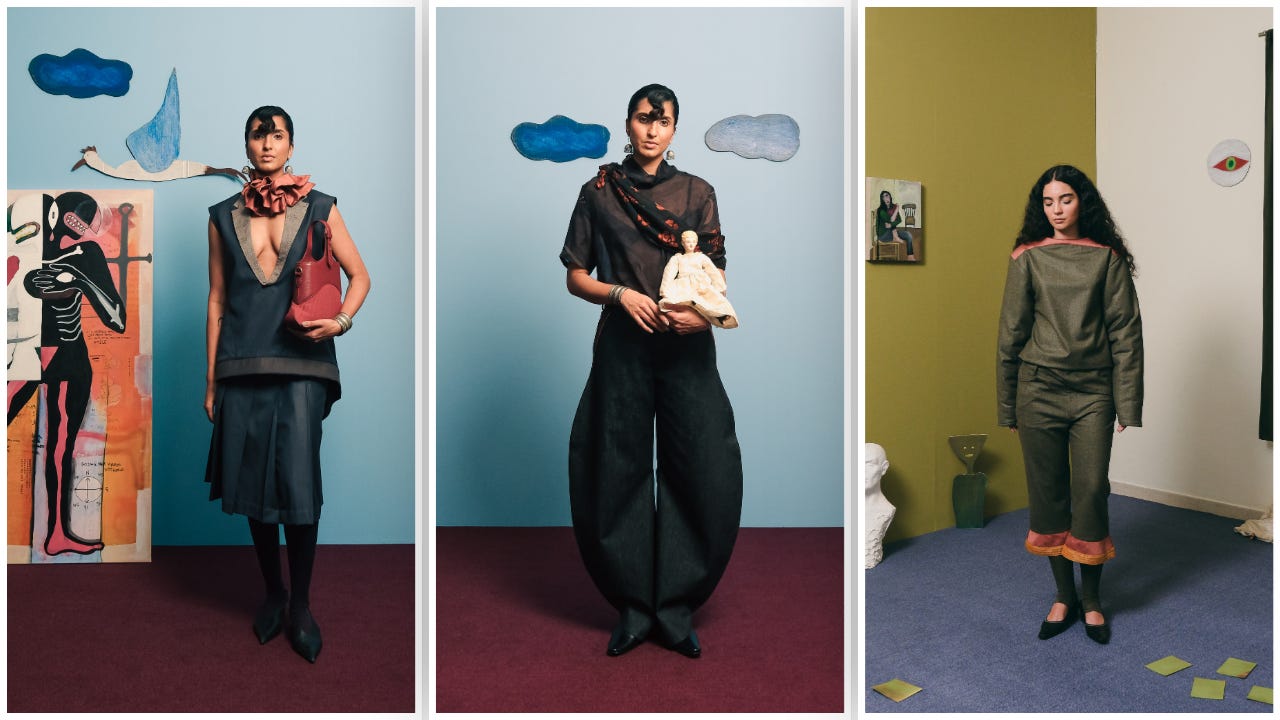
What’s the Color of My Voice? is a collection about choosing beauty without naïvety, discipline without rigidity, sincerity without spectacle.
It is a reminder that in a world where things often do not add up, making something with care can still be its own form of clarity.
Milan is loud this week, as it always is.
But if you were listening closely, past the noise, you would have heard something quiet a question, asked in a borrowed childhood room and stitched with a grandmother’s cloth, carrying further than anyone shouting ever could.
Before Milan tells you what fashion wants, Florence — at Pitti, days earlier tells you what taste has already decided.
This season, both of them paused to listen to a voice that came from somewhere else entirely.
That is the signal.
We would watch this one closely.
Absent Findings is available online at www. absentfindings.com, and through a considered selection of physical spaces: Ether at Yas Mall in Abu Dhabi, Serai Collective in Dubai, and Shabab Laboratory at Alserkal Avenue. It also moves through more temporary formats pop-ups, cultural events like SOLE DXB and BRED Abu Dhabi
Next: The craftsmanship behind status — The Italian Shoe: 200 Steps Before It Becomes Status.
Forward it to someone watching the new fashion language emerge.