


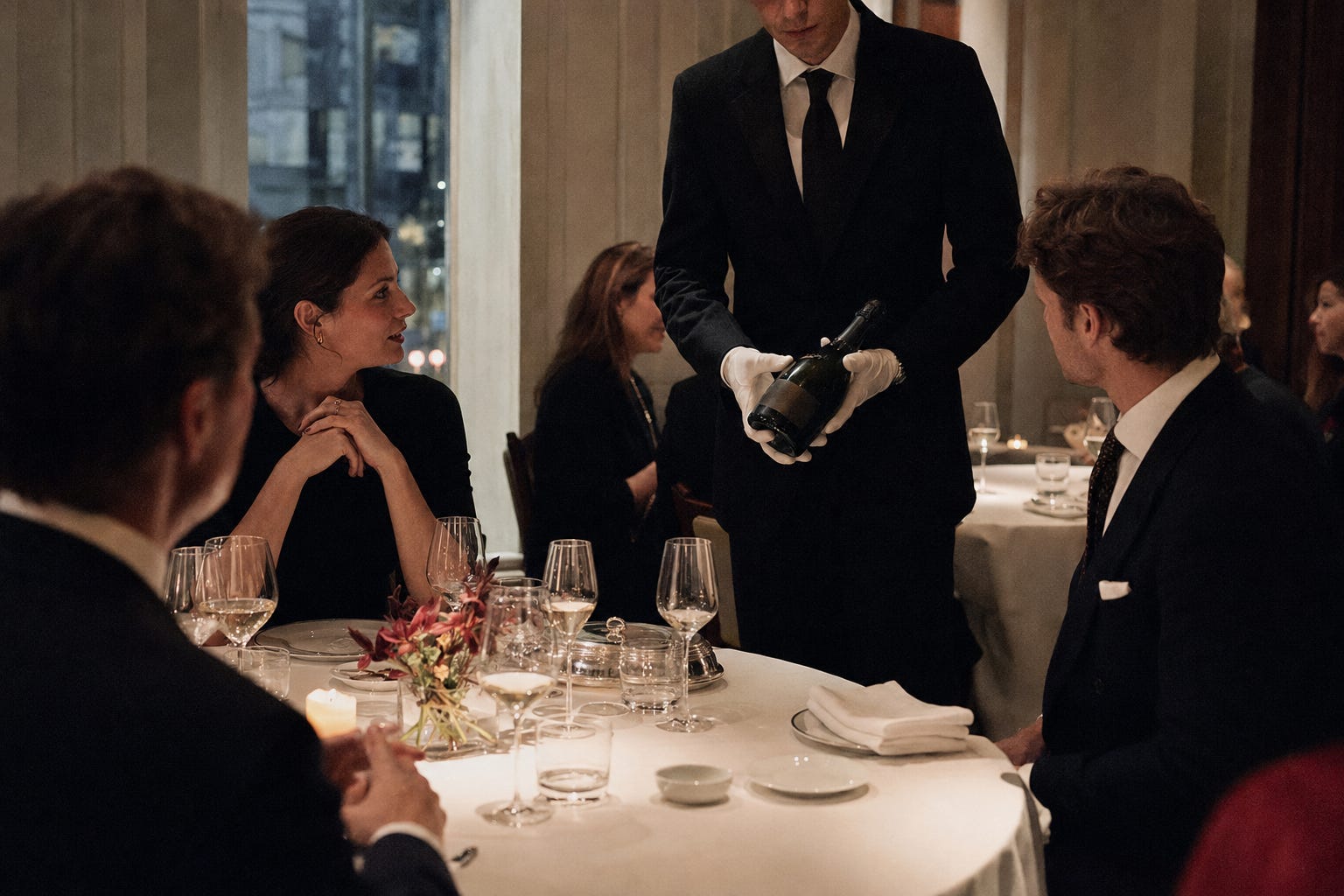
I once watched a man send back a perfectly good bottle of champagne in London because it had arrived too quickly.
There was nothing wrong with the temperature. Nobody had discovered a disappointing vintage or inspected the cork with sudden alarm. The sommelier had simply been efficient. He took the order, returned with the bottle and presented it almost immediately.
That, apparently, was the problem.
The man said something I couldn’t hear. There was no raised voice and none of the performance people sometimes use when they want an entire restaurant to witness their dissatisfaction. The sommelier listened, nodded and carried the bottle away.
It returned eleven minutes later.
I remember the eleven minutes because, by then, everyone at the table was aware that we were waiting. When the bottle came back, it was carried more slowly, almost ceremonially. It looked like the same bottle to me. I have always suspected that it was.
The man nodded. The champagne was opened. Conversation resumed.
My first reaction was not especially generous. I thought money had given a bored person the confidence to invent a new category of complaint. The champagne was too fast. How exhausting.
That explanation was satisfying because it placed me safely on the sensible side of the story. Still, I kept thinking about the bottle. It returned to me at strange moments over the next few years, usually when I was somewhere beautiful and could feel the experience being hurried along.
Eventually, I understood that the man had not rejected the champagne. He had rejected the speed of the transaction.
He had paid for an evening with its own rhythm, and the bottle had arrived as though the table needed to be cleared within the hour. The sommelier’s eagerness had punctured the atmosphere. Those eleven minutes put it back.
Was the whole thing a little precious? Of course it was. I am not going to pretend otherwise.
There is also a line between maintaining a standard and making hospitality staff suffer for your sense of importance. I have seen both, and I know the difference. This did not feel cruel. The man wanted no apology, replacement or public display of authority. He simply wanted the room to recover its pace.
That bottle became the starting point for The Opulence Issue.
Money matters
After years of watching money behave in public, I have learned that having it and knowing what to do with it are entirely separate skills.
Money matters. A beautiful room costs money. Privacy costs money. Time, space, craftsmanship and excellent service all cost money. It would be dishonest to turn opulence into another motivational idea and pretend that financial freedom has nothing to do with it.
But expense alone cannot produce the feeling.
We have all entered places where every surface was valuable and nothing felt generous. We have eaten costly dinners that seemed determined to prove their price before we had taken the first bite. We have seen clothes so heavily branded that the person wearing them almost disappeared.
Then there are other moments. A coat that has been worn for years and falls perfectly. A table where nobody reaches for a phone. A hotel that remembers what you asked for yesterday without announcing that it remembered. A host who notices you are cold before you have to say it.
The price may still be considerable. The difference is that the money has stopped asking to be admired.
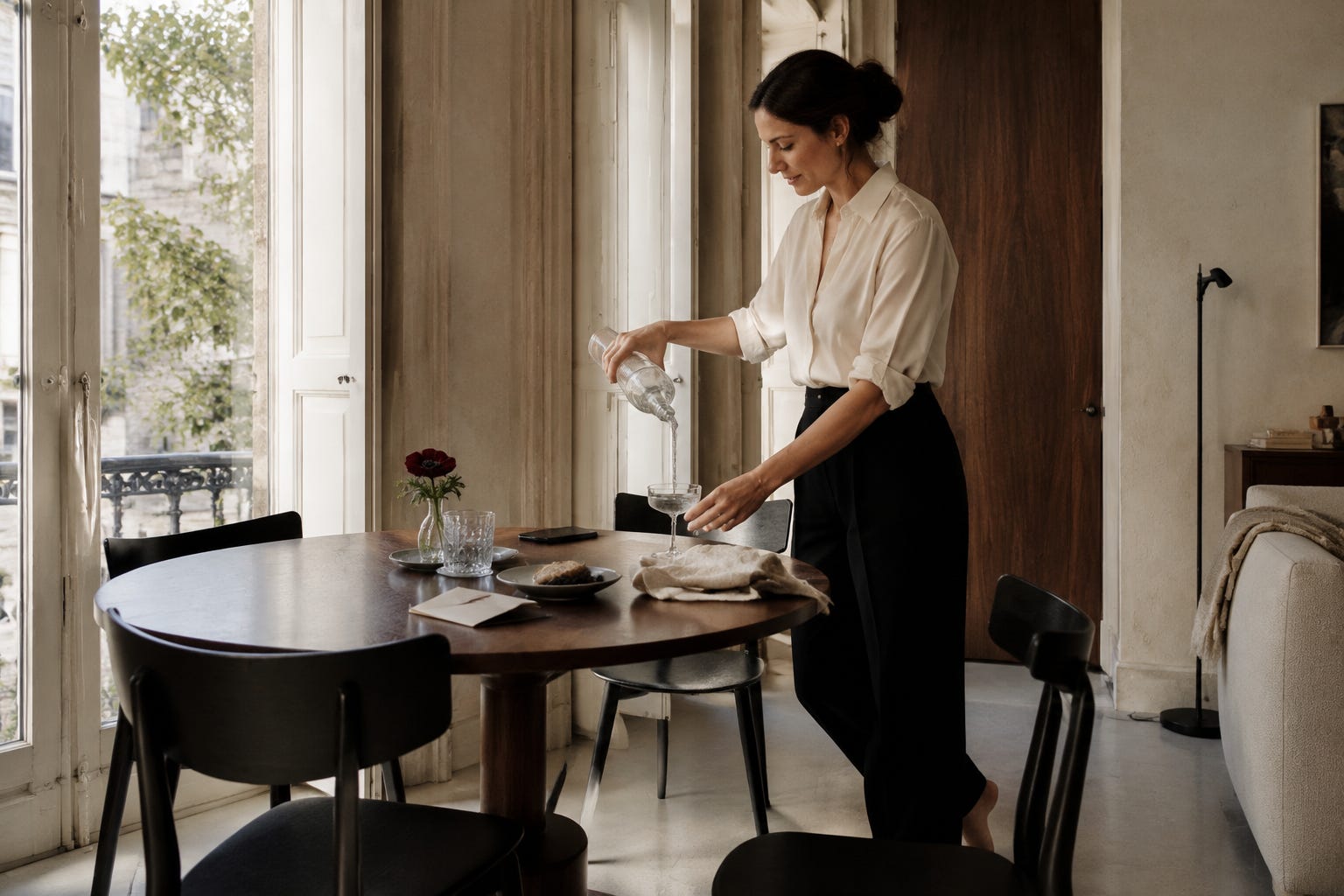
This is why I keep returning to discipline. Opulence is partly about access, certainly, but it is also about judgment: what to choose, what to leave alone and when to stop adding.
August will look at that judgment from several directions.
We begin with clothes and the woman who is never quite underdressed. She is not necessarily the woman wearing the most expensive dress. Usually, she is the woman who understood the invitation properly. She read the host, the hour, the setting and the purpose of the evening before she opened her wardrobe.
That kind of social intelligence cannot be purchased on the way to the event. I wish it could. It would have saved many of us from standing in front of a mirror wondering whether the outfit that looked perfect at home has somehow become completely wrong during the journey.
From there, we move to the making of an image. We will look at the work hidden inside a photograph that later appears spontaneous: the fittings, rejected angles, rehearsed gestures, timing and distribution. The public sees one apparently effortless second. A career may depend on everything that happened before it.
Then we turn to fragrance, perhaps the most private subject in the issue. A photograph records how a woman looked. Her fragrance becomes attached to how it felt to be near her. I will be writing about Amouage Guidance 46, a perfume I don’t simply admire from an editorial distance. I love it. That makes the piece more difficult to write, but probably more honest too.
Food and hospitality come next because appetite quickly exposes what image can conceal. A menu tells us what a restaurant wants us to desire. Service tells us whether a beautiful hotel knows how to care for an actual person once the photographs have been taken.
By the final week, we arrive at fame and reputation. We will consider visibility as work, the difference between being watched and being remembered, and what each sign privately wants attached to its name.
We will end with leaving. Not dramatically, and not because the evening has failed. We will leave because the moment is still good.
Knowing when to go may be the most difficult discipline of all.
A life that does not need proof
There is no shortage of opulence content. Much of it is filmed vertically, edited quickly and accompanied by someone telling us what we absolutely must experience.
I understand the appeal. OFFF DUTY also works with images, atmosphere and desire. We are not standing innocently outside the attention economy, looking in with disapproval. We make a magazine. We care deeply about how something looks.
But there is a difference between using an image to tell a story and arranging your life so that it can constantly provide one.
At some point during the past decade, nearly everything became evidence. The dinner needed to be documented. The hotel suite required a slow tour before anybody unpacked. The bag was positioned beside the coffee. The sunset was viewed partly through a screen because leaving it unrecorded felt strangely wasteful.
I am not judging this from a moral height. I have watched a beautiful plate cool while somebody found the correct angle. I have also understood the temptation. When a moment is exceptional, we want proof that we were there.
The problem begins when producing the proof becomes the main experience.
The market for performed wealth is now extremely crowded. We know the arrival sequences, the hotel doors, the watches placed near steering wheels and the champagne poured in slow motion. None of it shocks us anymore. Even envy becomes tired when it is asked to work this hard.
So our idea of value is beginning to move elsewhere.
A dinner nobody photographed feels unusual. Someone who does not explain every decision becomes interesting. The person who cannot be reached immediately appears to possess something many visibly successful people do not: ownership of their own time.
This does not mean silence is always tasteful or that privacy automatically makes a person profound. Some quiet rooms are simply dull. Some unavailable people are just unreliable.
The point is choice.
To be able to enter the room without needing it to confirm your value. To enjoy the holiday without turning it into evidence. To own something beautiful without placing it in the service of a personal campaign. To remain for as long as the evening is good and then go home.
That kind of freedom has become increasingly rare. Rarity, as luxury has always understood, changes the price.
The view from the guest’s chair
I should confess something before this begins to sound like a lecture delivered from behind a private door.
I have been the guest far more often than the host.
I have been the person checking the dress code twice, arriving with the priced menu and wearing the coat that would have been exactly right two seasons earlier. I know the small uncertainty of entering a room where other people appear to have received instructions that somehow never reached you.
That position has been useful.
People who have spent their whole lives inside certain rooms do not always see the machinery. Why would they? It is simply how the world works. People standing completely outside those rooms have to imagine what happens in them, and the imagination tends to make everything grander, colder and far more perfect than it is.
The guest sees both.
A guest notices who is greeted by name and who has to explain why they are there. She notices whether the room relaxes after the host arrives. She notices the difference between the service offered to somebody important and the service offered to the person sitting beside them.
She also notices that the woman everybody is watching may be worried about her dress, that the confident man has forgotten somebody’s name and that the supposedly effortless evening has a small army working behind it.
Proximity removes some of the fantasy without destroying the fascination.
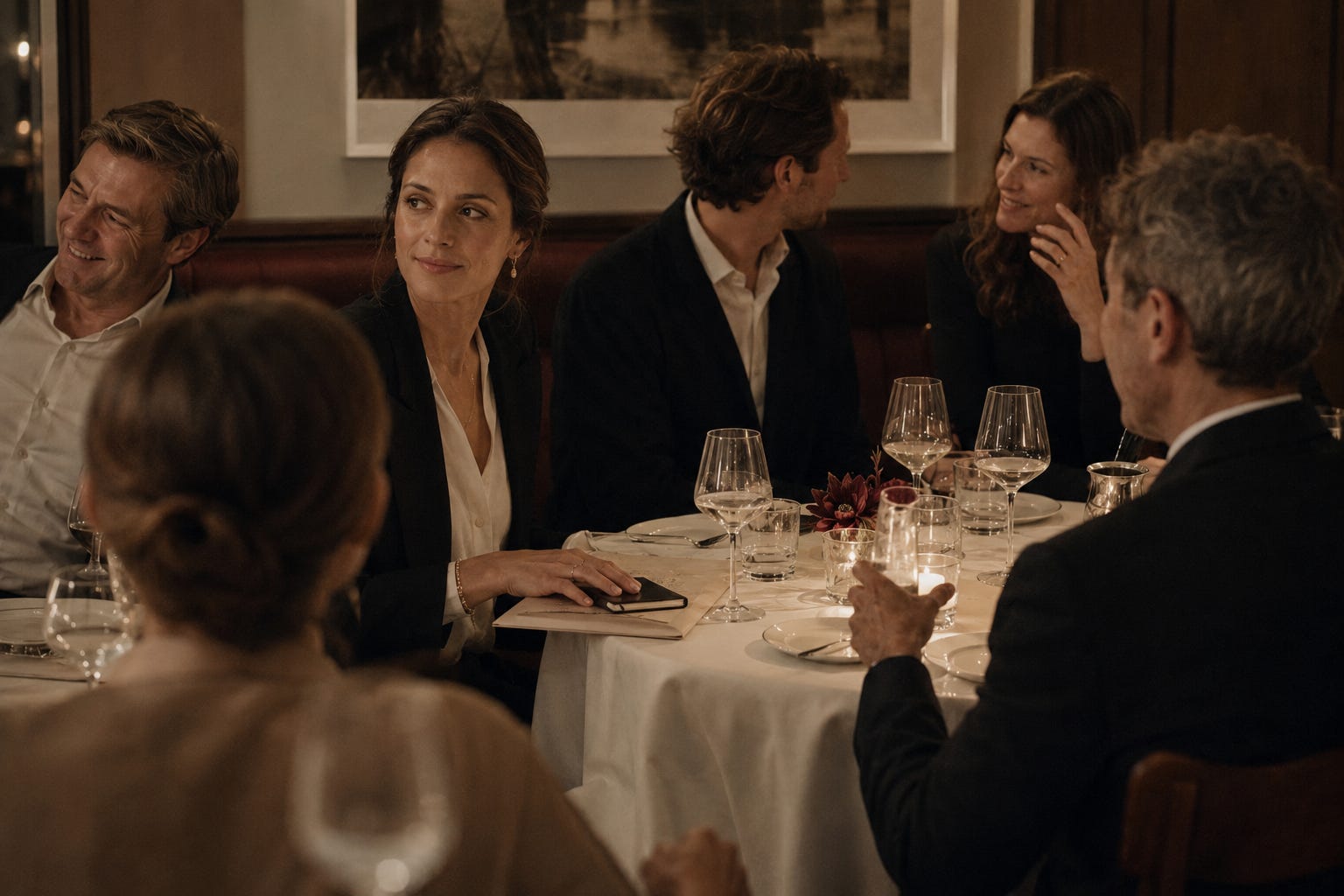
That is the position from which I write OFFF DUTY. These are not the diaries of someone who has always known every rule. They are the notes of a guest who learned by watching, occasionally by getting it wrong, and by asking why one room made people feel expansive while another made them perform.
This month, those notes will move through all five OFFF DUTY worlds.
On Tuesdays and Saturdays, we will consider dressing for the room, the making of a career-defining image, the private spell of Guidance 46, the hidden test inside a menu, the service a beautiful suite cannot fake, and the work required to remain visible without surrendering your entire life to visibility.
The August horoscope will look at reputation rather than romance. On Monday, 31 August, we will close the issue with the art of leaving at the crest of an evening.
You can read each essay alone, but together they form a larger question: what is all this beauty actually for?
I don’t think it is there to make other people feel small. I don’t believe the best room is automatically the most exclusive one, either. Beauty is most convincing when it changes the quality of our attention. It asks us to slow down long enough to experience what we worked so hard to reach.
So I have one request this month.
Read at least one essay all the way through before deciding what it is.
I realise the audacity of asking this on the internet. Every platform has trained us to judge writing by its opening line, and every editor, including me, has learned to make that first line work harder. But the argument of an essay does not always live at the beginning. Sometimes it arrives late, after the writer has changed her mind once or twice.
The man in London finished his champagne close to midnight.
He did not order another bottle.
That was the detail I understood last. If his intention had been to display how much he could spend, another bottle would have appeared before the first was empty. Instead, he drank what he had chosen and stopped when it was finished.
At the next table, three bottles arrived. I remember the procession of them, but almost nothing about the people who ordered them.
I remember the first bottle because it was allowed to take its time.
That is how I would like us to read August: slowly enough to notice something, and with the discipline to know when enough has been said.
Subscribe free to receive The Opulence Issue. And if this letter made you think of somebody whose life has become too available, forward it to them.
Certain identifying details have been changed to preserve privacy.
Live beautifully. Keep something for yourself.
Maria Knight Paccheco
Founder & Editor-in-ChiefOFFF DUTY