


Let’s begin with what fashion is afraid to say out loud.
Most brands are performing. They perform ethics. They perform heritage. They perform cool. They perform the kind of considered restraint that is itself a performance and somewhere inside the theatre of it all, the clothes become secondary to the story being told about them.
Absent Findings walked in and changed the frequency.
The first thing you notice is not the tailoring. Not the deadstock. Not even the South Asian vocabulary running quietly through the clothes like a current underneath still water.
It is the silence around the work.
Weighted. Intentional. Completely unafraid.
The brand does not rush to explain itself. It does not arrive wrapped in the ready-made language of sustainability, emerging markets, heritage, identity, craft, or cultural representation although every one of those readings is available, if you insist on them. It does not beg the audience to understand where it comes from before the clothes have had the chance to stand in front of them and make their own argument.
Absent Findings gives you the work first.
Then it waits with the patience of something that already knows what it is to see whether you know how to look.
That education lives inside Absent Findings, but it never announces itself.
It is not quoted. It is absorbed the way a city gets into your posture. You feel it in the way the garments carry structure without shouting construction. In the way a collar reads as an idea before it reads as a reference. In the particular discipline of refusing to make something look complicated only to prove that it was hard to make.
There is a kind of designer who needs you to notice the labour.
Singh seems far more interested in whether the labour has become inevitable whether the work has reached the point where it could only ever have looked exactly like this, and the struggle to arrive there is no longer visible at all.
The founding constraint that every collection is built substantially from deadstock and existing materials, with around 70% of the work developed from sourced deadstock rather than newly produced fabric could have become the entire story. In lesser hands, it absolutely would have. The contemporary fashion market knows precisely what to do with a sentence like that. It extracts it, titles it, and files it under values.
Absent Findings does something far more interesting.
It refuses to let deadstock become a slogan.
For Singh, the process is instinctive but ferociously disciplined. He is not sourcing with a fixed outcome already waiting for confirmation. He is looking for material that carries charge in texture, in colour, in feeling, in the strange living weight of something that has already existed before the designer found it. The fabric is not blank. It arrives having already been somewhere.
And that somewhere is not discarded. It is worked with.
A lot of materials come with limitations: restricted quantity, inconsistencies, irregularities, imperfections, the slight stubbornness of fabric that refuses to behave like a clean production brief. In most fashion systems, those limits are problems to route around. At Absent Findings, they become the first instruction.
The material dictates.
The designer listens.
That reversal is the entire point. Conventional fashion begins with an image and sources toward it the world bending to the vision. Deadstock begins with what already exists. The design is not imposed. It is negotiated, argued, earned. A fabric that exists in limited quantity may decide the scale of a garment. A texture may decide the silhouette. A colour may simply refuse the mood board completely, and the mood board has to move.
This is harder than designing from scratch.
It is also why these clothes do not feel like they were made to fill a calendar slot. They feel found, pressed against, cut, reconsidered at three in the morning, and finally, finally allowed to become themselves.
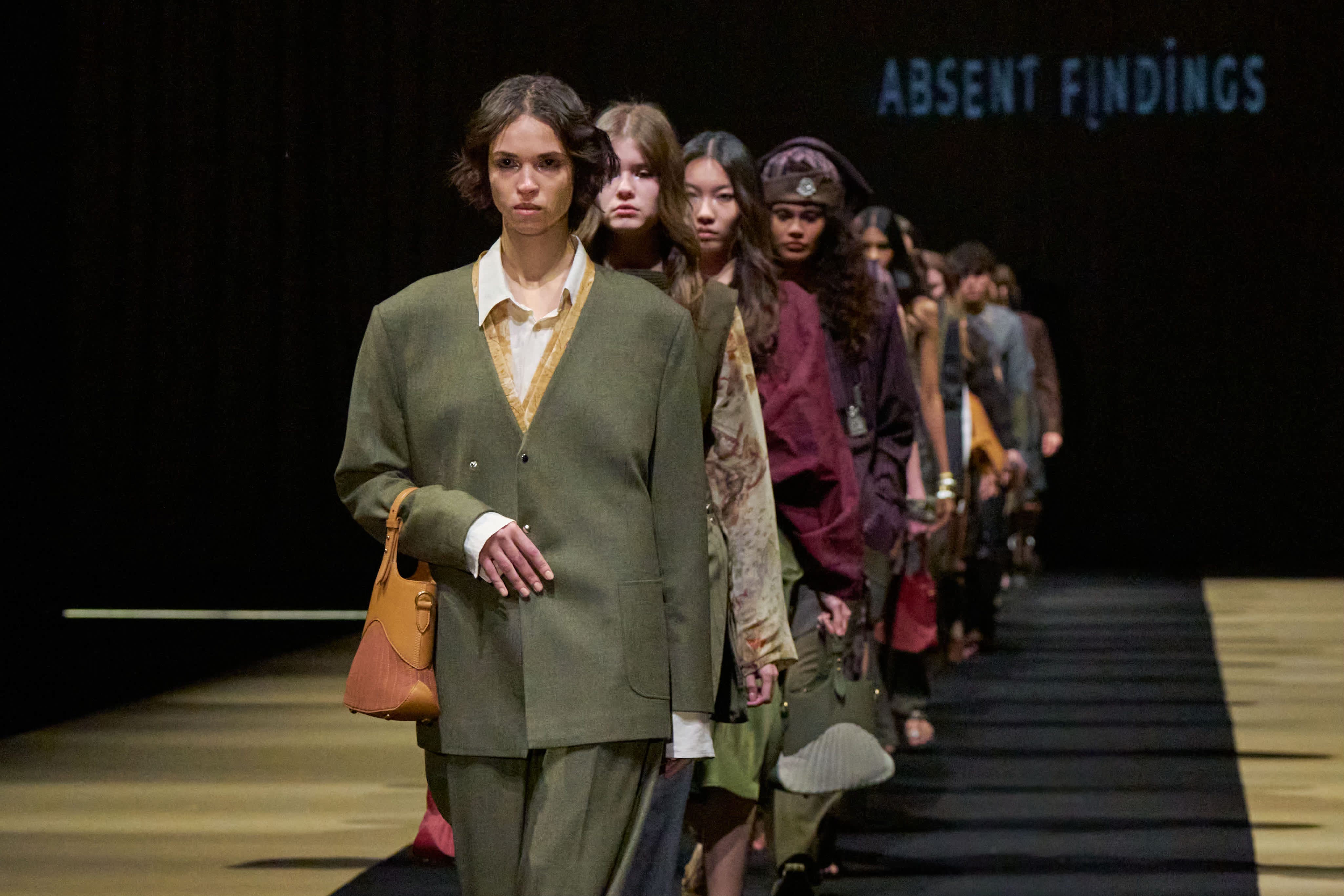
The triangle that produced Absent Findings: Florence for training, India for cultural vocabulary, UAE for production sounds, on first hearing, like the kind of neat biography that fashion was invented to package. Three locations. Three clean influences. A story that fits a caption.
But the work is not that tidy.
Florence gives the discipline of object-making the understanding that luxury is not a price point but a density of decisions per square centimetre. India gives a tailoring language that is older, more technically complex, and more formally rigorous than the Western fashion system has ever been honest enough to acknowledge. The UAE gives the working reality: production infrastructure, regional energy, the specific electricity of building something from a place that the industry still treats as a destination for selling rather than a geography capable of authorship.
Together, these three things do not produce a brand story.
They produce a method.
The Bandhgala collar. The Chunnat pleat. The Darbar coat silhouette. These are not ornamental gestures toward cultural heritage. They are not inserted to announce diversity or soften a garment’s foreignness into something an international audience can appreciate from a comfortable distance. They are not decorative. They are structural. They are used because they solve problems that other solutions cannot solve as precisely.
They hold the body differently. They structure weight differently. They carry authority in the way that only things built from deep knowledge not borrowed reference are able to carry it.
Singh uses them because they are correct.
Not because they are legible.
That distinction is the sharpest edge in Absent Findings’ entire proposition, and it cuts cleanly through the most dishonest habit in contemporary fashion. The industry has become extraordinarily fluent in cultural reference as surface: a motif positioned with care, a neckline borrowed with reverence, a press release written with the precise vocabulary of appreciation to ensure that extraction does not read as extraction. But there is another way to work with cultural inheritance older, more difficult, and incomparably more serious: not as image, but as intelligence.
The difference between cultural reference as signifier and cultural reference as solution is everything.
One produces costume.
The other produces clothing.
Absent Findings produces clothing.
And because of that because the references are embedded in construction logic rather than applied to the surface as decoration the work resists the laziness of quick recognition. You may not know the name of the pleat. You may not identify the origin of the collar in the first moment. But you can feel, viscerally, when a garment has been built from knowledge rather than assembled from mood.
That feeling does not leave.
It is why the clothes stay with you after the image is closed, after the page is turned, after the room is empty.
Not because they explained themselves.
Because they withheld just enough to make you need to look again.
In Singh’s process, the material begins to shape the collection before the silhouette has fully resolved before the designer has decided what he is making, the fabric has already started narrowing the possible answers. How it falls. How it holds or refuses structure. How much of it exists in the world. Whether repetition is possible at all, or whether this thing can only ever be made once. Whether a piece should be pursued further or abandoned entirely to the honest fact of its own limitation.
These are not styling questions.
They are questions of existence.
A collection, understood this way, is not designed.
It is discovered under pressure found in the gap between what the material will allow and what the designer refuses to give up on.
The collection names live in exactly that gap.
My Personal References for Fall/Winter 2025/26.
Early to the Party for Spring/Summer 2025/26.
Not What You Think for Autumn/Winter 2026/27.
None of this sound like mood board titles. They sound like positions taken before an argument begins. Slightly guarded. Slightly charged. Unwilling to deliver comfort before it has been earned. They suggest a designer who is fully aware of being looked at and who has decided, with absolute clarity, that he will not perform the expected version of himself for that gaze.
Not What You Think may be the most precise statement in the whole body of work.
Not because it refuses interpretation.
Because it refuses the lazy kind.

What makes this restraint feel so exactly right for this moment is that it arrives inside a fashion culture that has become terminally addicted to explanation.
The contemporary brand is trained to narrate itself before anyone has asked a single question. The mission statement lands before the garment. The founder story publishes before the first cut. The sustainability credentials are listed before the material has been touched by a human hand. The cultural reference is translated, contextualised, softened, and pre-captioned for immediate, frictionless consumption.
This is routinely described as transparency.
Sometimes it genuinely is.
More often, it is a very well-dressed anxiety.
Brands over-explain when they are afraid the work cannot hold the room without assistance. They explain to lock in approval before judgment begins. They explain to pre-empt the discomfort of the unfamiliar. They explain to convert the complex into something purchasable within the first thirty seconds of attention. And in doing all of that explaining, they sacrifice the one thing no amount of language can replace: the right of the object to remain genuinely complex.
Absent Findings refuses that bargain not loudly, not as manifesto, but with the specific composure of work that has already settled into its own terms.
The clothes do not arrive with the desperate politeness of a young brand petitioning for inclusion. They arrive like something that has already decided. That quality that settled, unperforming certainty is rare at any level of the industry. From a label barely over a year old, it is almost unreasonable.
Sustainable. Emerging. Regional. Genderless. Heritage-driven. Craft-led. Conscious. Contemporary.
Every one of these words may technically apply.
Not one of them is sufficient.
The danger of these categories and it is a real danger, with real consequences for real work is that they function as cages. Once a brand is introduced through them, the audience stops looking and starts filing. The work becomes an example of something rather than a thing in itself. A South Asian designer becomes “South Asian representation.” Deadstock becomes “sustainability.” A Dubai-based label becomes “regional emergence.” Technical tailoring becomes “heritage.” The vocabulary is not wrong. It is simply far too small for what is actually here.
The intelligence the particular hard-won intelligence of Absent Findings is that it does not deny these readings. It simply refuses to surrender to them before the work has been encountered on its own terms. A collar is first a collar. A pleat is first a construction decision. A fabric is first a material with limits, with weight, with memory, with resistance. Only after the object has been met as an object can it become narrative.
That order is everything.
It is the difference between fashion that uses identity as surface and fashion that allows identity to shape the method from the inside. Between a garment designed to signal where it came from and a garment designed with the technical mastery of where it came from. Between representation as display and representation as intelligence.
This is why Absent Findings reads as more serious than its age should permit. It is not behaving like a young brand. It is not confusing visibility with authority. It is not mistaking press for proof or noise for presence.
It is building a language carefully, incrementally, with the patience of something designed to last and it is building it slowly enough that the audience has to develop the fluency to meet it.
In a fashion culture that rewards the instantly legible, that is not merely brave.
It is a position.
And positions, held with this kind of consistency, become institutions.
The timeline is worth documenting in full, because it shows what happens when a brand knows its own coordinates before the industry has decided how to classify it.
April 2025: launch. September 2025: Lineapelle Designers Edition in Milan and recognition at the Black Carpet Awards as one of the New Waves 2025 in Fashion. December 2025: Fondazione Sozzani exhibition. January 2026: official Milano Fashion Week digital presentation for Not What You Think. January 21, 2026: Lakmé Fashion Week GenNext Top 10. February 3, 2026: Dubai Fashion Week runway debut, presented by Polimoda with the support of the Arab Fashion Council.
Less than twelve months from launch to institutional fashion spaces on three continents.
Without changing the work to get there.
That is not momentum. Momentum can be manufactured. This is something rarer: the compression that happens when coherence becomes legible before consensus has arrived to validate it. The brand did not wait to be discovered in the right room by the right person. It appeared in the right rooms because the work created its own gravitational pull.
The press that followed across Italian fashion media, regional luxury platforms, cultural titles, and international style publications that do not ordinarily occupy the same conversation is significant not only for its range but for what that range reveals. When a brand can move between institutional fashion coverage and younger cultural platforms without adjusting the work to suit each audience, it means the work contains multiple points of entry without needing to perform differently at each door.
That is what genuine coherence produces at scale.
Not simply a larger audience.
A more attentive one.
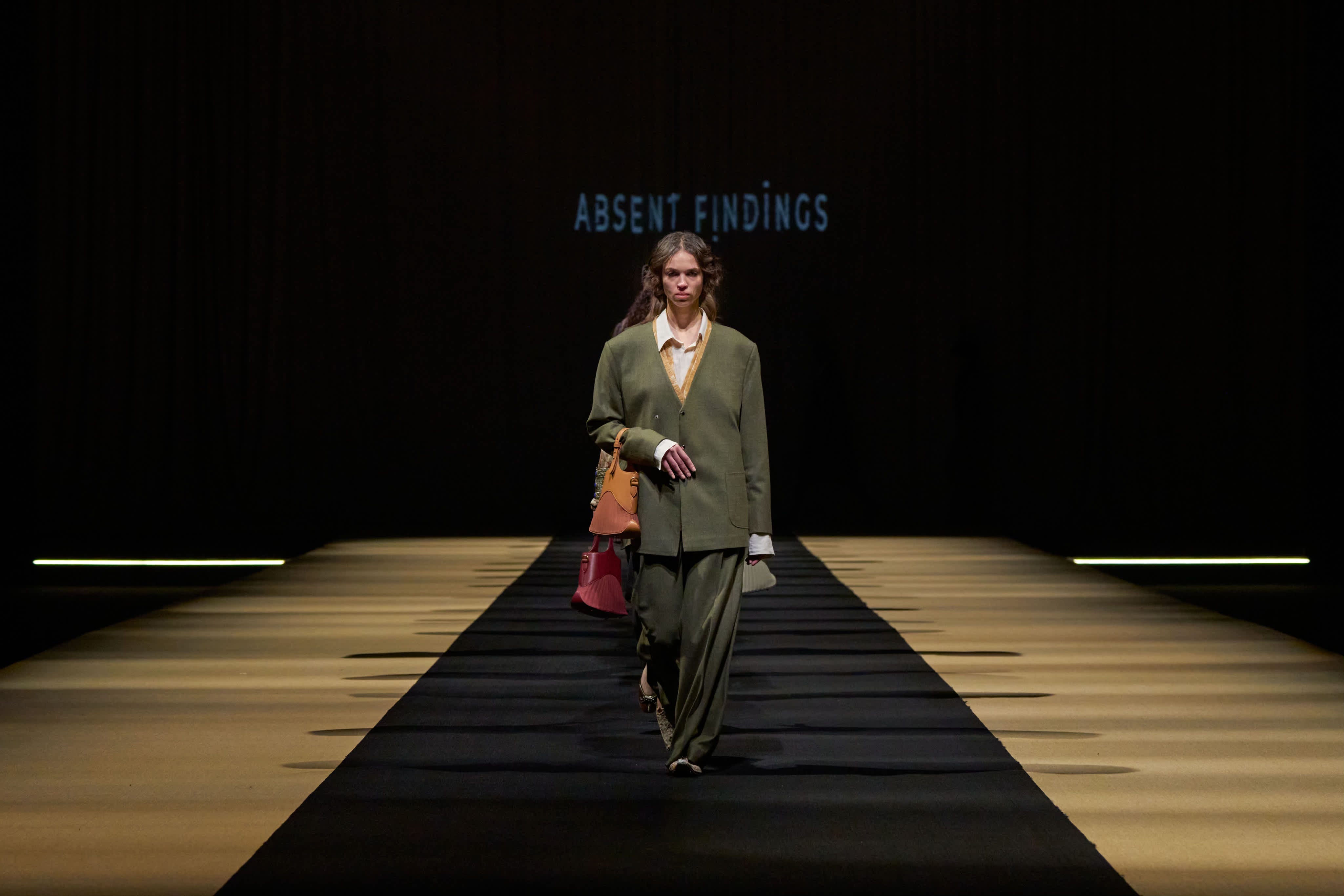
Production remains intentionally controlled. That detail is important and easy to misread.
In fashion, scale is the default proof of success. More stock. More doors. More drops. More content. More visible, more legible, more everywhere. But scale is also the precise moment when a young brand can lose the intelligence that made it worth scaling in the first place. It can convert method into merchandise before the language has had the time to fully set.
Singh’s approach is not growth by volume first. It is growth by clarity the understanding that proximity to the work is itself part of the method, and that the method is the product.
This is not smallness as limitation.
It is smallness as control and control, at this level of intention, is not a constraint. It is the creative condition that makes everything else possible.
The control also illuminates something essential about the customer that Absent Findings is building toward. Not a demographic. Not a city. Not a lifestyle archetype dressed in elevated fabric. Singh describes the customer less as a profile than as a disposition: someone attentive to construction and the intelligence behind a piece. Someone who does not need the garment to explain itself within the first few seconds of encounter. Someone with the confidence the specific, earned confidence to wear something that will not be immediately recognised and not feel the absence of that recognition as a lack.
That is a very specific customer.
And in a market that has spent twenty years training people to want the opposite the logo, the obvious silhouette, the item that announces its relevance before it has been touched a brand that can locate and dress that customer is not filling a niche.
It is defining a new standard for what fashion is allowed to ask of the people who wear it.
The seduction of Absent Findings is not about status. It is not about trend. It is not even, ultimately, about aesthetics though the aesthetics are extraordinary.
It is about the particular luxury of being dressed by something that does not need to perform for you.
The luxury of clothing that does not become obvious. That rewards proximity rather than distance. That carries its intelligence without ever turning intelligence into decoration. That asks, quietly and without apology, for a wearer who has moved on from needing to be told what to think about what they are wearing.
That is the most private luxury available in fashion right now.
And Absent Findings is one of the rare young brands currently offering it with this much clarity.
Every decision in this body of work returns to the same refusal.
The refusal to overproduce. The refusal to over-explain. The refusal to convert every material decision into content and every cultural reference into credential. The refusal to make origin into spectacle or difficulty into branding. The refusal perhaps the most radical refusal of all to mistake immediate comprehension for success.
Absent Findings is available online at www. absentfindings.com, and through a considered selection of physical spaces: Ether at Yas Mall in Abu Dhabi, Serai Collective in Dubai, and Shabab Laboratory at Alserkal Avenue. It also moves through more temporary formats pop-ups, cultural events like SOLE DXB and BRED Abu Dhabi not as a distribution compromise but as a deliberate choice about context. The work is contextual. It should be encountered in motion, in rooms where things are still being decided, not only in the clean stillness of retail.
The most revealing thing about Absent Findings is not the speed of its trajectory.
It is that the logic has never changed.
Material. Construction. Naming. Production. Distribution. Press. Customer. Every single decision refers back to the same centre of gravity: do not simplify the work to make it easier to consume. Do not explain more than the work requires. Do not mistake the audience’s comfort for the goal.
Trust the clothes.
Let the clothes be difficult.
Let the difficulty be the point.
This is what the most interesting fashion has always understood and what the industry keeps almost forgetting in its anxiety to be legible, shareable, and immediately validated. That fashion, at its best, does not translate itself for you. It asks you to come to it. It builds a language. And if the language is built with enough rigour, enough patience, enough refusal to compromise the intelligence for the sake of the reach eventually, the world learns to speak it.
Absent Findings is at the beginning of that.
And you are reading this at exactly the right moment to understand what that means.
Not because the brand has explained itself beautifully.
Because it has understood, from the very first garment, that the most important fashion begins precisely where explanation stops.
You do not want this translated.
You want it.