



There was a shelf in my bedroom that I have never fully dismantled.
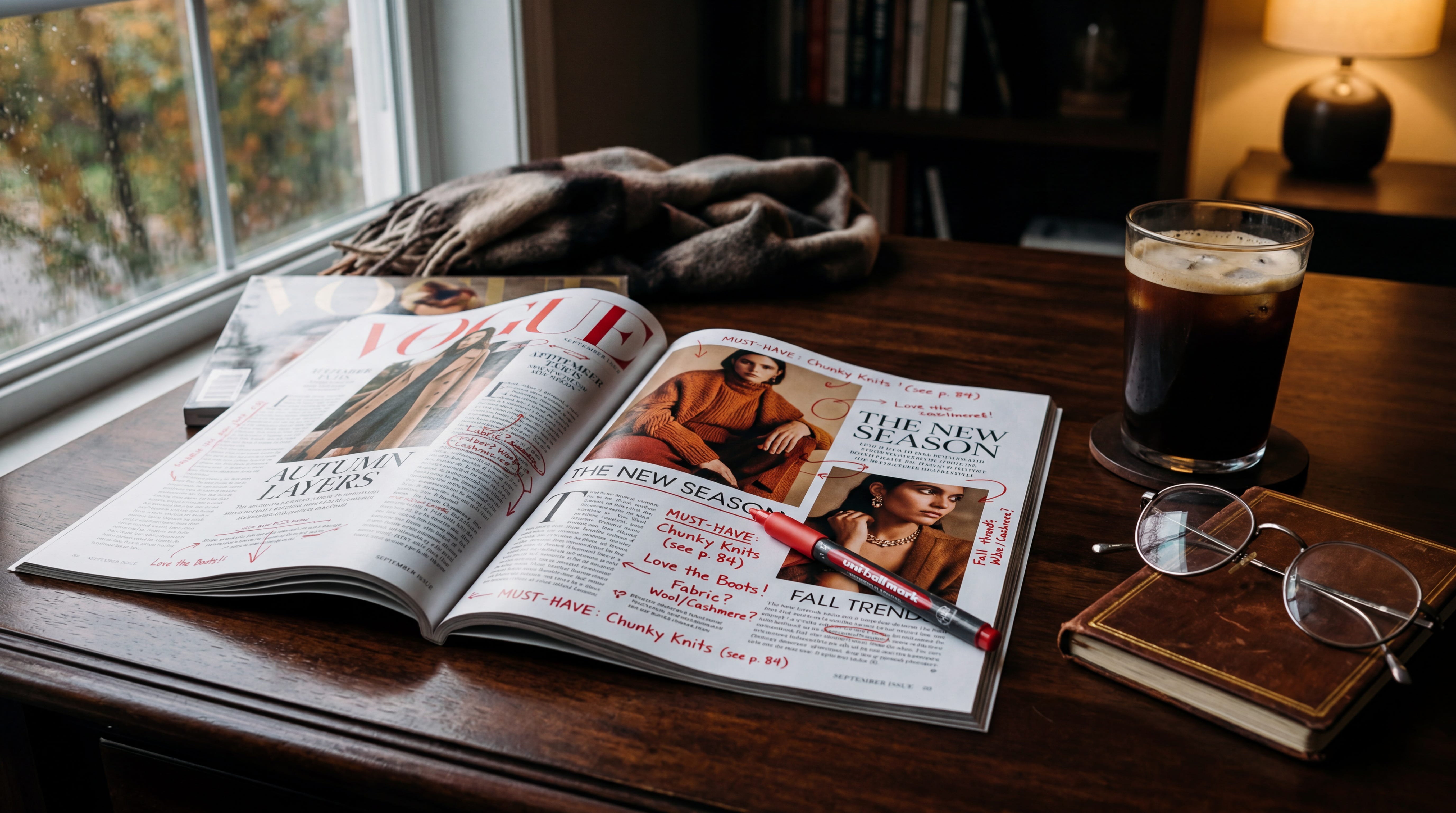
Elle. Vogue. Harper’s Bazaar. Not stacked the way you store things you are done with arranged, spine-out, the way you keep evidence of something that mattered. I started reading those magazines before I understood what they were doing. I read them the way you read something that is teaching you a language you did not know you needed: layout, rhythm, restraint, authority, and the peculiar confidence of a cover line that can carry an argument in six words.
I was not reading them for the clothes. I understood that later. I was reading them for the logic, the way a great editor could take something as apparently frivolous as a jacket and make you understand it as cultural evidence. The way a well-constructed beauty page was not about products but about a particular vision of what a woman’s relationship with herself could look like. I was studying, without knowing the word for what I was doing, a form.
What those magazines taught me, before I had the vocabulary to articulate it: that a publication can be commercially serious and editorially fearless at the same time. That restraint is a position, not an absence. That the best cover lines do not describe they seduce and then withhold. That an editor’s letter is the most important piece of writing in the entire issue, and the one most likely to be written last.
The Shelf
There is a specific kind of knowledge that accumulates in children who read above their station.
I was not fashion-obsessed in the way that word is usually deployed as a shorthand for shallow enthusiasm or compulsive consumption. I was interested in systems. In how things worked. In why a particular photograph felt different from another, technically identical photograph. In why some writing made you lean forward and other writing made you check the time.
The magazines on that shelf were my first education in the mechanics of desire. Not manufactured desire the cheap kind, produced by repetition and availability but cultivated desire, the kind that requires you to understand something before you want it. The kind that emerges from context, argument, and specificity.
Elle taught me that a publication could hold contradiction without resolving it. It could be glamorous and rigorous. Commercial and curious. It could carry an advertiser’s brief on one page and a genuinely dangerous piece of cultural commentary on the next. That tolerance for complexity, I later understood, was not accidental. It was editorial intelligence, the ability to hold a room with a variety of occupants without making any of them feel they were in the wrong place.
Vogue taught me architecture. Not the fashion, the structure. The way an issue builds: the hierarchy of sections, the rhythm of long and short, the photographs that carry meaning before the words arrive. The cover as thesis. The editor’s letter as premise. The closing pages as something like a coda. Reading Vogue carefully which is to say, reading it the way a writer reads anything is to study one of the most sophisticated editorial forms in commercial publishing.
Harper’s Bazaar taught me restraint. Which is the hardest lesson, and the most valuable. That not explaining a thing sometimes says more than the explanation. That leaving space is not timidity. That authority does not announce itself, it arrives quietly, and you feel it before you can name it.
I still feel it. I return to those issues now, as an editor myself, and the feeling has not changed. What has changed is my ability to describe what I’m feeling, and why.
The Door That Did Not Open
I am going to write this section without self-pity, because self-pity is both dishonest and uninteresting.
I wanted, for several years, to work inside the rooms those magazines represented. Not specifically in those publications, though that was part of it. In that world, the world where taste is the qualification, where what you notice matters more than what you studied, where your perspective on a hemline or a hotel or a cultural moment is taken seriously as a form of intelligence.
The door did not open the way I expected. This is not a euphemism. The door genuinely did not open, and I had to decide, at some point, what that information meant.
What I have learned, not comfortably, and not quickly is that closed doors are not necessarily refusals. Sometimes they are redirections. Sometimes they are the room itself failing to understand what it is looking at. Sometimes they are simply the wrong door, and the right one is not visible yet because you are standing too close to the wall.
I am not interested in performing that realisation as if it arrived easily. It did not. There were years of building something nobody had named yet, years of developing a point of view in the absence of an audience that could validate it, years of continuing because stopping felt like a larger failure than the uncertainty of continuing. Those years are not behind the story. They are the story.
What I want to resist and what I see collapsed in almost every “how I built it” narrative circulating as content is the compression of that period into a single sentence. I didn’t get what I wanted, so I built my own thing. As if the “so” were effortless. As if the gap between wanting access and developing the authority to build your own room were a footnote rather than the entire text.
The gap is the text. The gap is where this publication was built.
Why OFFF DUTY Exists

OFFF DUTY is not a rejection story. It is not a revenge project. It is not an exercise in proving something to rooms that were not paying attention.
It is a publication for the reader who already understands aspiration but has outgrown the version of it that requires performance. The reader who has spent enough time in the rooms literal and metaphorical to understand that the most interesting conversations are not happening at the largest tables. Who has moved through the phase where visibility was the goal and arrived somewhere more specific: authority, usefulness, depth, taste that does not require an audience to confirm it.
I built OFFF DUTY because the magazines that raised me are still among the finest editorial achievements in their form and because there is a conversation they are not having, a reader they are not quite speaking to, a register they have not found. Not because they lack the intelligence. Because the commercial structure of a major publication makes certain conversations difficult to have consistently, at length, without apology.
OFFF DUTY has none of those constraints. It has, instead, the particular freedom of building something from scratch: the freedom to decide what the publication is interested in, what tone it takes, who it speaks to and how, what it considers evidence and what it considers noise.
That freedom is mine in a way that a commissioned column or a staff position would not have been. And the work that comes out of it is different because of that.
What June Is About
Every issue of OFFF DUTY begins with a thesis before the sections are assigned.
June’s thesis is this: the most considered choices are the ones made without an audience.
The jewellery worn closest to the skin. The career decision nobody posts about until it is already complete. The table that has nothing to prove. The object bought for longevity rather than for legibility. The beauty routine built around evidence rather than trend.
We are living through a cultural moment in which taste has become performance to such a degree that the performance is frequently mistaken for the thing itself. What OFFF DUTY is interested in, what this June issue is specifically about is what happens when you remove the audience from the equation entirely.
What would you choose then? What do you already choose, when nobody is watching?
That question runs through every section of this issue. The Opulence section asks it about objects. The Fame section asks it about visibility. The Fashion section asks it about clothes. The Food section asks it about tables. The Beauty section asks it about skin.
The answers are different. The question is the same.
If this is the first time you have read OFFF DUTY, this letter is the right place to start. If you have been here from the beginning, this letter is also for you an accounting of where this started and what it has become.
The June issue is already building. The archive is where it lives permanently.
The Editor