


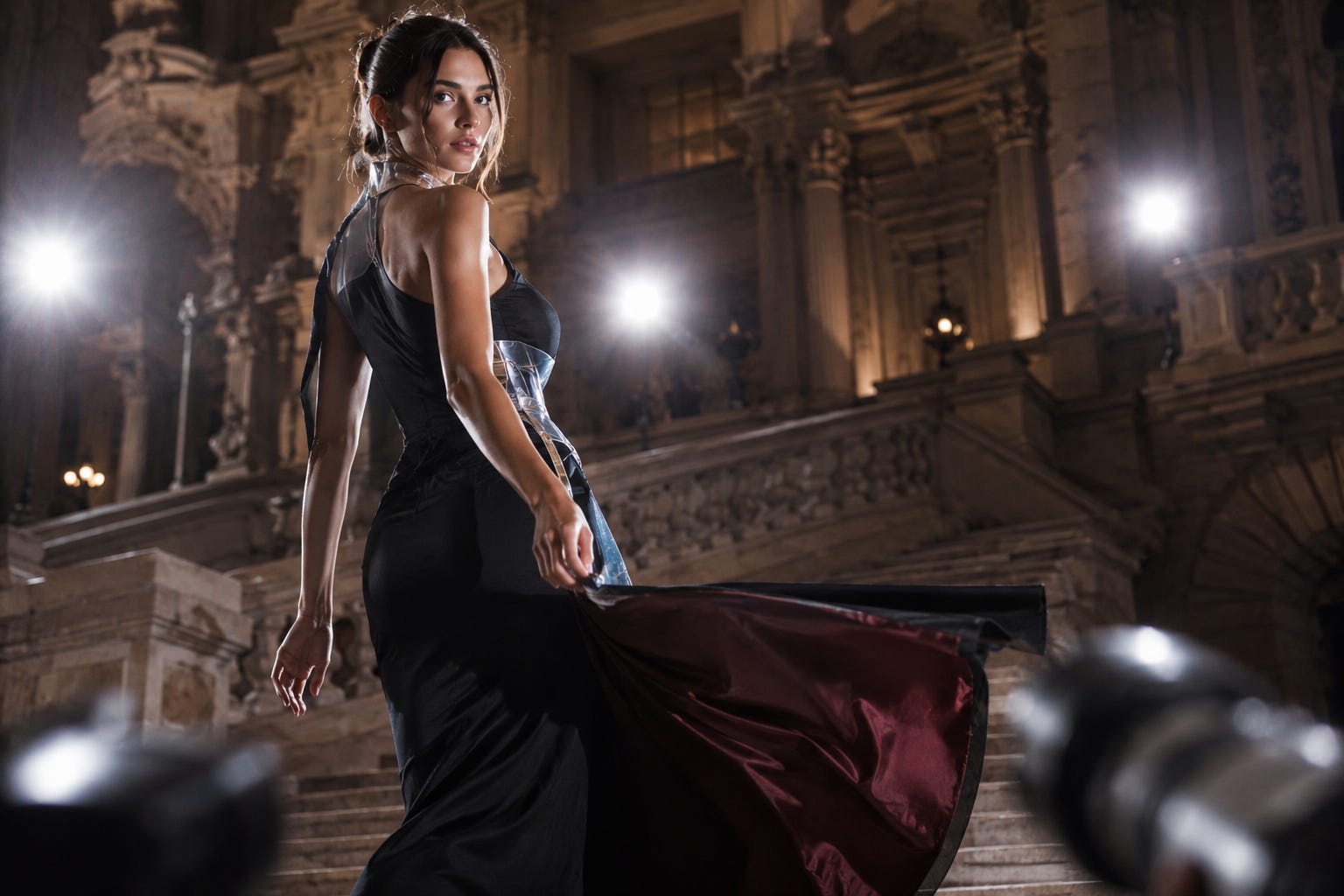
I knew the photograph before I knew the dress.
Chrome shoulders. Transparent panels. A body made briefly mechanical under the white violence of red carpet flash. Zendaya standing inside something that looked like it had been sent back from the future, and had in fact been made almost thirty years ago.
You did not need to know it was Mugler. You did not need to have seen Dune: Part Two.
You did not need to care about archival fashion, or the mythology of the original runway show, or how nearly impossible it is to persuade a house to release something that fragile and that important.
The photograph explained itself before any of that arrived. This woman was not attending the premiere. She had taken possession of it.
By morning the image was everywhere. Different angles, different crops, the same conclusion. The rest of the carpet had become background. The photograph did what defining images do: it removed the need for the argument.
Then the invisible story began to surface.
The suit came from Thierry Mugler’s autumn 1995 couture collection, pulled from the archive for the London premiere. Law Roach later described the privilege of being allowed to touch it, never mind receiving permission for Zendaya to wear it. Every part of it fit her, including the shoes. He cried.
That reaction matters, because the image was not the product of one clever evening. It belonged to a partnership that had been developing for thirteen years. The public received a surprise. Zendaya and Law Roach had built a language.
My title is not entirely honest
One photograph does not change a career.
The work has already been happening. The roles, the introductions, the disappointments, the fittings, the negotiations, the private decisions, the slow years of becoming more precise: all of it sits outside the frame. A camera cannot manufacture authority where none exists. Point a lens at someone who has not done the work and you get a costume. But a photograph can do something almost as powerful. It can make the world recognise the change all at once.
Most careers evolve gradually, from the inside. Public perception moves far more slowly, because the old version of a person is familiar, convenient and easy to file. People keep using the category they already have. It costs them nothing.
Then one photograph arrives and makes the old category impossible to maintain. The image does not create the transformation. It gives the transformation evidence.
That is why certain pictures feel larger than fashion. They settle an argument the subject has been having with the culture for years, sometimes without ever saying a word about it out loud.
Not a child star. Not merely beautiful. Not the person standing next to the important person. Not promising. Arrived.
Every defining image has a sentence inside it
Nobody prints the sentence beneath the photograph. It is there anyway.
This is an arrival.
This is authority.
This is control after disorder.
This is a person your old description can no longer hold.
When that sentence is clear, every element starts working for it: the clothes, the background, the posture, the timing, the empty space around the body. Nothing is decorative, because everything is arguing. When the sentence is missing, styling collapses into decoration. The dress gets admired. A beauty account reposts the hair. Someone asks where the shoes are from.
By the next morning the image is gone. A defining photograph does something harder than please people. It leaves the public with a new instruction for how to see the person inside it. Test it on any image you can still picture years later. There is always a sentence in there. You absorbed it in less than a second and you have been repeating it ever since.
The dress was only the visible part
It is tempting to credit the object.
The Mugler suit was extraordinary. Chrome catches a flash in a way silk never will. Transparent panels turned the body into part woman, part machine. Its history carried a cultural weight that no newly delivered gown can manufacture overnight.
But remarkable clothes are photographed badly every single day. The object still needed the right woman, the right story and the right moment.
Zendaya was not wearing an archival suit because vintage happened to be fashionable. The appearance belonged to a carefully constructed press tour in which the clothing extended the world of the film. Roach explained that the looks drew on the story’s futurism and its characters; the clothes were not publicity decorations parked next to the film, they were part of its narrative. As he told Vogue, the Mugler piece required the cooperation of the house’s archive team and permission to bring a piece of fashion history back into public life.
That is what made the photograph feel inevitable immediately after it had shocked us.
The look was surprising. The logic was complete. Those are different things, and the difference is everything.
Surprise without logic produces a stunt. Logic without surprise produces competent publicity. The rare image contains both: something you did not expect, followed instantly by the certainty that nothing else would have been as right.
The garment did not simply say futurism. It said access. Risk. Fashion literacy. Physical discipline. Trust between a woman and the person helping to build her image.
All of that entered the photograph before a single article explained it.
The body has to know before the camera does
We talk about memorable photographs as though they were accidents.
The fabric happened to move. The face happened to turn. The hand happened to fall exactly there. Sometimes accident supplies the most beautiful detail in the frame. But accident is unusually generous to people who have prepared for it.
A difficult garment has to be learned.
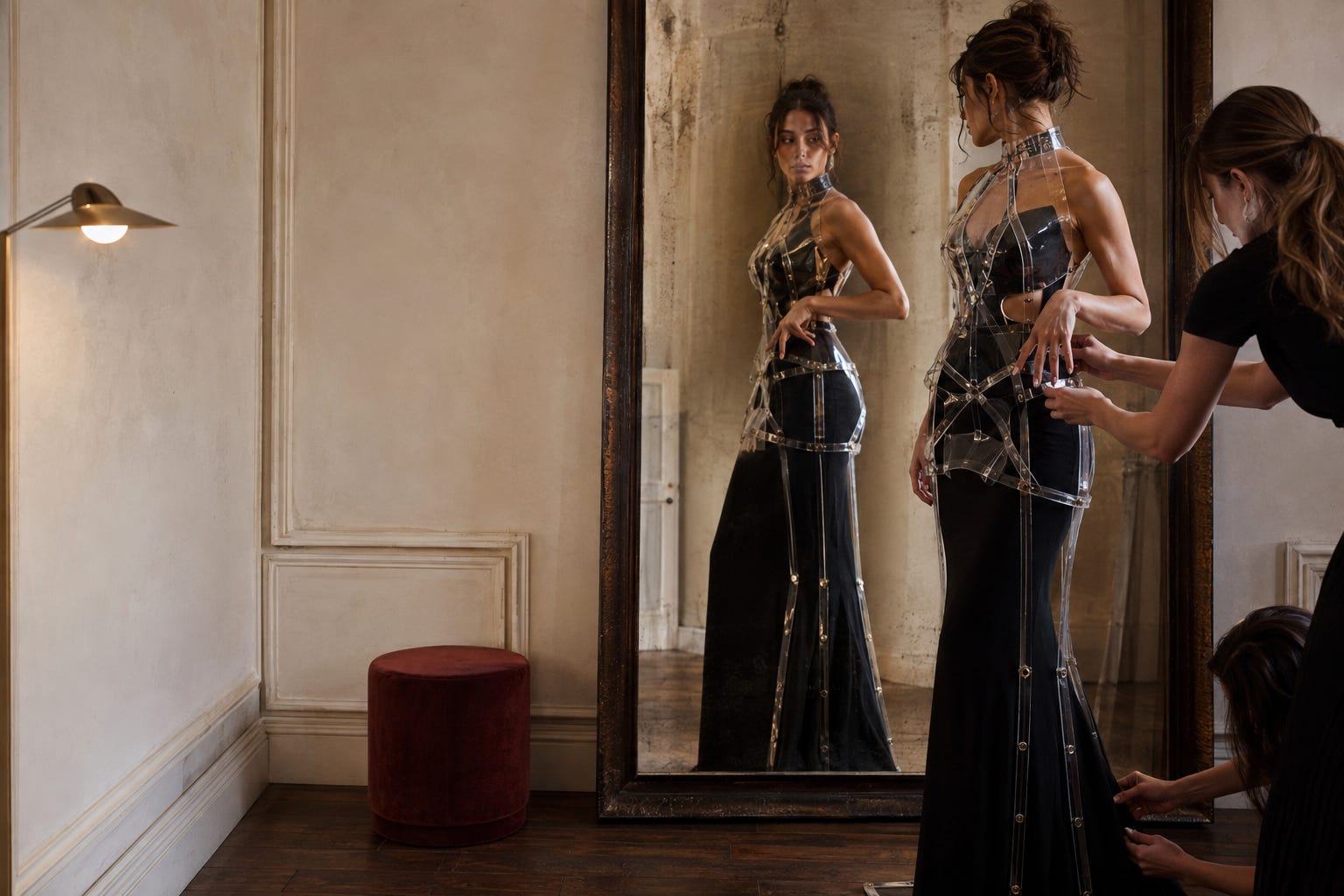
Where can she move? Where can she not? Which angle lets the silhouette be understood in a quarter of a second? What happens when she sits? Can she raise her arm? How long can she hold the position before the effort starts showing in her face?
None of these questions are glamorous, which is exactly why you never see them.
You see one hand resting at the hip. You do not see the hours that taught a body where the garment ends. You see a still expression. You do not see a woman regulating her breathing under hot lights while photographers shout her name from twenty directions at once.
We mistake preparation for falseness because we have romanticised spontaneity. But rehearsal does not necessarily drain the humanity out of an image. It can protect it.
When the wearer no longer has to negotiate with the dress, she becomes free to respond to the room. A small expression escapes. The shoulder turns differently. The hand stops performing. For half a second the plan relaxes, and life gets in.
That is usually the frame we remember.
Not because nobody prepared, but because the preparation created enough safety for something unplanned to survive.
OFFF DUTY looks beneath the finished image, at the decisions, labour and cultural signals that made it matter. Subscribe free to continue The Opulence Issue.
The photograph has to survive the room disappearing
A defining image now lives in two places. The first is physical: a staircase, a doorway, a stage, a street. The second is a phone.
The subject may spend several minutes moving through the real setting. Almost everyone will meet her later, inside a crop, for less than a second, between two other things. That changes what the image has to accomplish.
Scale has to survive reduction. Colour has to stay recognisable. The silhouette has to keep making its argument after the architecture, the crowd and the atmosphere have all been stripped away.
Rihanna’s yellow Guo Pei cape at the 2015 Met Gala understood this completely.
On the Metropolitan Museum’s staircase, the enormous train answered the scale of the building. On a phone screen, the saturated yellow and the circular shape stayed instantly identifiable. Even when the photograph became a meme and was severed from fashion context almost entirely, the visual code survived intact.
Years later, the Metropolitan Museum itself included the cape among the gala’s defining moments.
That is the second life of a successful image. First it interrupts the present. Then it enters the archive.
The strongest photographs can be cropped, reposted, imitated, mocked, celebrated and rediscovered without ever losing ownership of their original moment. Context disappears. Identity remains.
Which is why beautiful is not an image strategy.
Beauty becomes anonymous at small sizes. A defining image needs a shape, a colour, a gesture or a tension strong enough to remain itself after everything explanatory has been removed.
Timing supplies the voltage
The same look, worn six months earlier, might have meant nothing. Timing does work that styling simply cannot.
A first public appearance after an absence. A role that changes the perceived altitude of a career. A premiere attached to a powerful visual universe. A moment when the previous version of a person has finally become too small for them.
The calendar creates the question. The photograph arrives as the answer.
This is where serious teams separate themselves from people who merely own beautiful clothes. They understand sequence.
Not every appearance should try to be historic. If every look demands maximum attention, none of them has anywhere left to rise. One appearance establishes the visual language. Another complicates it. The defining one arrives when public interest is already at its peak.
Then comes the part almost nobody copies: restraint.
Zendaya changed out of the Mugler suit later that evening into a comparatively quiet black Mugler gown. That decision protected the first image. The story had already reached its climax. There was nothing to gain from competing with it.
The public experienced one extraordinary moment. The team had edited an entire evening.
History is a selection problem
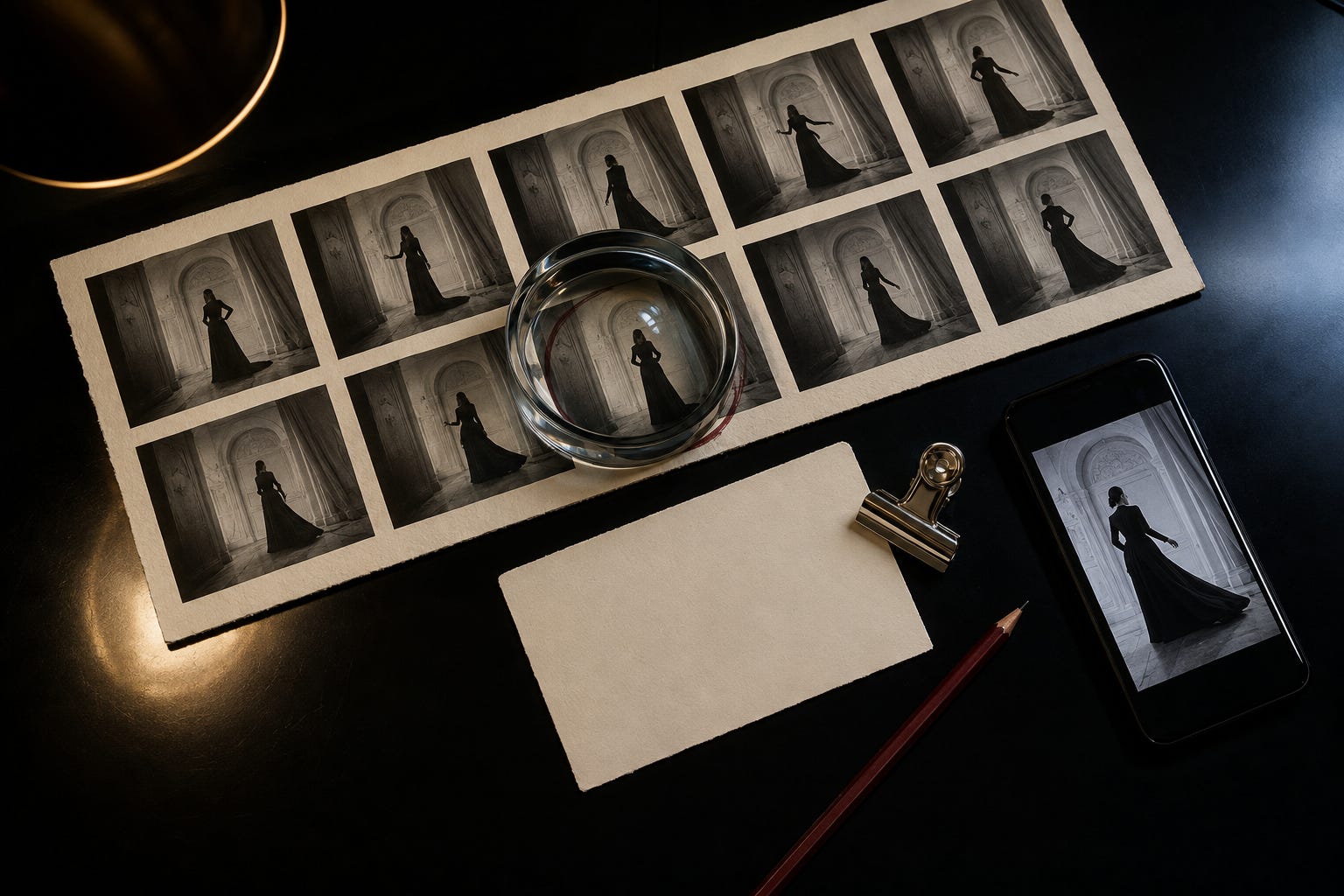
A photographer may take hundreds of frames. History does not keep them.
One image becomes the first post. One angle leads the article. One crop travels from the stylist’s account to the publication, to the fan page, to the archive, to the anniversary retrospective five years later.
Repetition creates recognition, but only when the evidence stays consistent.
Ten nearly identical photographs do not strengthen a moment. They dilute the gesture. A backstage image released too early punctures the reveal. A long explanation offered before curiosity has formed asks the audience to do work the picture should have done on its own.
The strongest sequence is usually remarkably small. One photograph that contains the argument. One detail that rewards a second look. One sentence that gives the image context without explaining away its mystery.
Then, later, one piece of process that quietly reveals what the apparent effortlessness actually cost.
Fame is not exposure. It is the disciplined repetition of the right evidence.
Before you take the picture
None of this is only a celebrity exercise.
A founder announcing a company. An artist entering a more ambitious chapter. A writer publishing a first book. A professional becoming publicly visible for the first time.
The stage is different. The question is the same:
What should this photograph allow people to understand?
Not what will you wear.
Not where will you stand.
Not which references are saved to the mood board.
What must become visible now?
Write one sentence before the fitting, before the shoot, before the announcement: After seeing this image, people should understand that…
Then hold everything up against it.
Does the silhouette survive on a phone?
Does the setting strengthen the message, or does it only look expensive?
Is there enough control to create clarity, and enough humanity to stop the image becoming an advertisement?
Why must this photograph arrive now, rather than in six months?
Which single frame will lead?
And the question almost nobody asks: what are you going to resist releasing?
The photograph that alters the public reading of a career is rarely an accident, even when accident contributes its most beautiful detail. It is a meeting between preparation and life. The flash simply makes the meeting visible.
If this changed the way you look at a photograph, subscribe free to OFFF DUTY for the rest of The Opulence Issue.
Then send it to the person whose work has already changed, but whose public image has not caught up yet. They will know exactly why you sent it.