


The most interesting thing about fashion month this year was not a trend.
There was no single colour dominating the conversation, no dramatic silhouette editors rushed to declare as the defining look of the season, no singular show that reset the mood overnight and sent the industry chasing a new aesthetic direction.
If anything, the absence of those signals was what felt most noticeable.
Instead, something quieter began to take shape.
Across New York, London, Milan, and Paris, designers working in entirely different languages of fashion — from sharp tailoring to fluid minimalism, from heritage houses to newer voices — began arriving at instincts that felt unexpectedly aligned. Not identical, not coordinated, but recognisably similar in intention.
It did not announce itself immediately. It revealed itself slowly, almost reluctantly, through repetition.
Collection after collection.
Look after look.
Until eventually the pattern became impossible to ignore.
Clothes looked… protective.
Not in the theatrical sense of armour or confrontation. Nothing about the runways suggested defence as aggression. The instinct was more subtle than that, almost internal. It appeared in the way garments held their shape, in the way layers accumulated, in the way fabrics carried weight instead of movement.
It appeared in silhouettes that seemed to gather around the body rather than open it up to the world.
Fashion is often described as escapism, a space where imagination briefly replaces reality. Yet anyone who has spent enough time around collections understands that fashion rarely escapes the world for long. It absorbs the emotional climate of the moment almost immediately, translating it into proportion, material, and rhythm before it is fully understood in words.
Designers may speak about art, cinema, or personal references, but the deeper logic of a season tends to emerge somewhere else.
It lives in patterns no single designer controls.
And this season, that pattern felt unmistakable.
Protection.
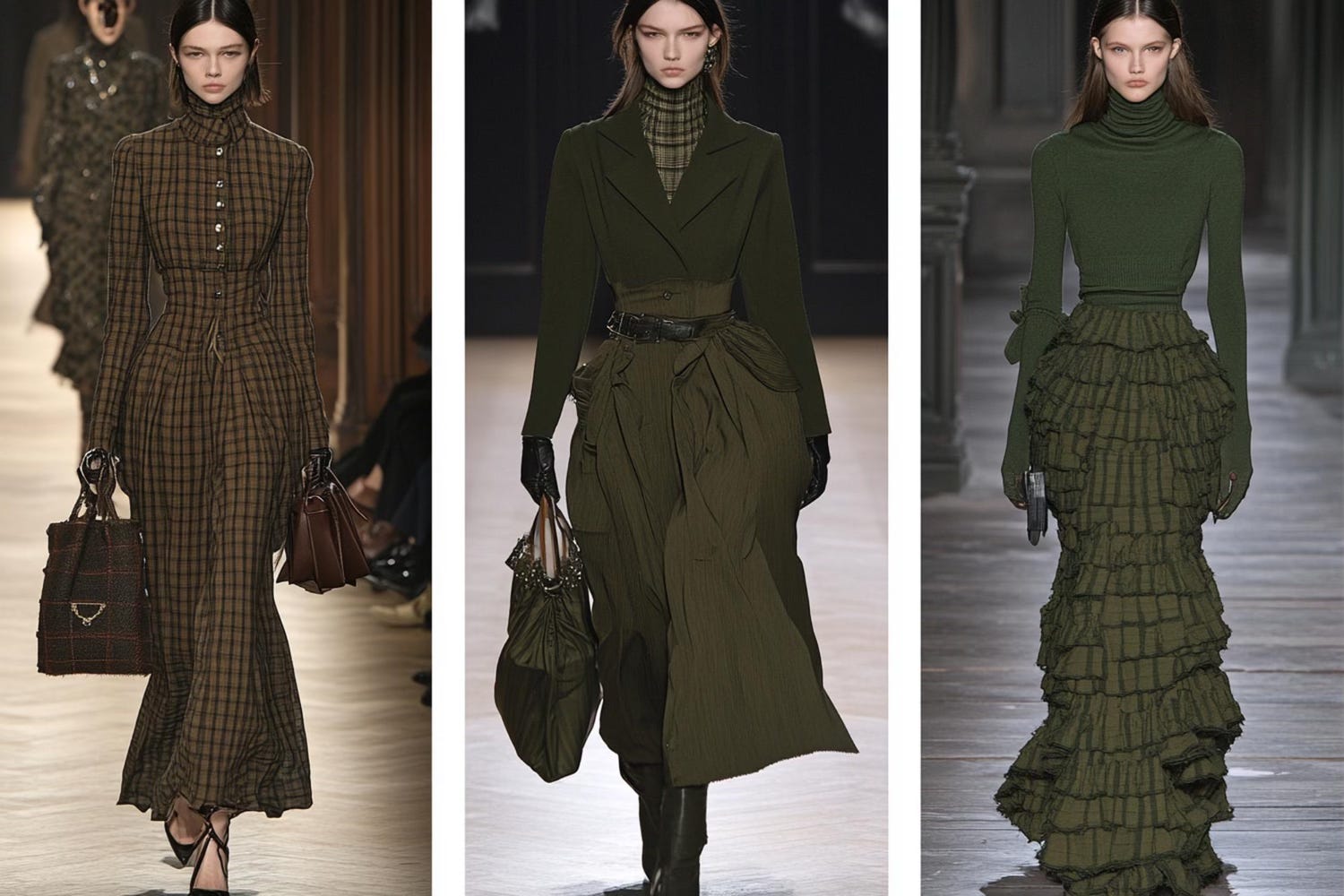
At first, the instinct was difficult to articulate precisely because it refused to behave like a conventional trend.
The industry prefers clarity. A dominant colour. A defining silhouette. A single visual idea that can be named, repeated, and sold.
But what appeared this season resisted that kind of simplification.
Instead, designers were making dozens of small, almost quiet decisions that only made sense when viewed together.
Coats extended in length, often falling below the knee, sometimes approaching the ankle. Shoulders regained subtle strength, restoring a sense of architecture to the upper body without tipping into exaggeration. Layering returned, not as styling excess but as structure — shirts beneath knits, coats over tailoring, scarves integrated into the silhouette rather than placed on top of it.
Even fabrics carried intention.
Wool, leather, heavy cotton, dense knits — materials that hold their shape, that resist collapse, that create a boundary between the body and the outside environment. Textiles that feel present rather than fleeting.
The effect was not dramatic.
But it was unmistakable.
Clothes began to feel less like decoration and more like environment. And the colour palette reinforced the same instinct with quiet discipline.
Deep burgundy. Charcoal grey. Chocolate brown. Dark olive. Midnight navy.
These colours have always existed within fashion. What felt different this season was not their presence, but their persistence. They appeared again and again, across houses that otherwise share very little aesthetic territory.
It suggested something beyond coincidence.
These tones do not demand attention. They stabilise it. They behave like architecture rather than ornament. They allow form, proportion, and material to carry meaning without distraction.
Designers, consciously or not, seemed less interested in announcing something new than in reinforcing something reliable. And that distinction matters. Because fashion rarely moves toward stability without reason.